
The smartest money goals for 2027 are specific, dated, and automatic: build a starter emergency fund, trim four recurring bills, attack high-interest debt, and invest at least enough to capture any employer match. Set a dollar target for each goal, schedule transfers on payday, and review progress monthly.
Key Takeaways
- A $1,000 starter emergency fund stops one surprise bill from landing on a credit card.
- A $6,000 card balance at the current average card rate generates about $112 in interest every month.
- Maxing out a 401(k) in 2027 takes $2,125 per month, but the full employer match matters more for most workers.
- An index fund charging 0.05% a year costs $5 on a $10,000 balance, while a 1% fund costs $100.
- A 30-minute monthly money review catches overspending before it compounds.
What Are Money Goals?
Money goals are specific, time-bound financial targets, such as saving $1,500 by June 30, that turn a vague intention into a number you can track. Strong goals name three things: the amount, the deadline, and the account where the money will sit. Every goal in this BetterThisWorld list follows that format.
Which Money Goals for 2027 Should You Tackle First?
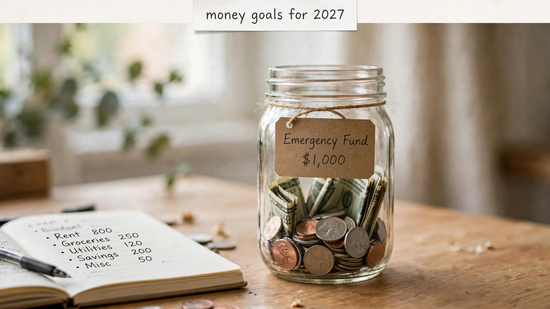
Start with cash safety, then high-interest debt, then investing. That order stops new debt from piling up while old balances shrink.
Only 63% of U.S. adults said they would pay a surprise $400 bill entirely with cash or its equivalent, according to the Federal Reserve’s Economic Well-Being of U.S. Households in 2025 report. Flip it around: roughly 37 of every 100 adults would need to borrow, sell something, or fall behind. Goals 1 through 4 move you out of that group.
- Build a $1,000 starter emergency fund by March 31. Keep it in an FDIC-insured high-yield savings account at a separate bank, one transfer away instead of one swipe away.
- Write a zero-based budget for January. Assign every take-home dollar a job until nothing is left unassigned; if that feels too rigid, the 50/30/20 split of needs, wants, and savings works as a simpler first draft.
- Automate savings on payday. A $25 transfer every two weeks adds $650 across 26 pay periods without a single decision.
- Grow the fund to three months of essential expenses by December. Count only rent, utilities, groceries, insurance, transportation, and minimum payments. At $3,200 a month in essentials, the target is $9,600, so the remaining $8,600 works out to about $956 a month from April through December.
Irregular bills wreck more budgets than daily spending. Total your annual costs, such as car registration, gifts, and insurance premiums, and divide by 12; a $2,400 yearly total means $200 a month into a separate sinking fund.
Anyone asking how to manage money effectively can borrow the core rule of this stage: give every savings goal a fixed amount and date, then remove the decision by automating it.
How Can You Cut Bills Without Feeling Deprived?
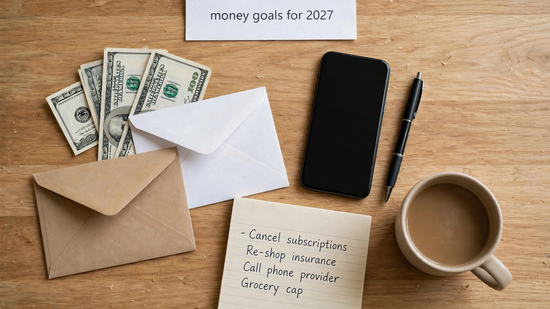
Cut the bills you pay automatically before touching the purchases you enjoy. Recurring costs repeat, so one phone call saves money twelve times.
- Cancel or downgrade three subscriptions in January. Scan 90 days of statements for repeat charges, including free trials that quietly turned paid.
- Re-shop car and home insurance 30 days before renewal. Compare three quotes with identical limits and deductibles. Raising a deductible from $500 to $1,000 lowers the premium, but only once your emergency fund can absorb the higher amount.
- Call the provider’s loyalty team, cite a rival’s price, and check whether a prepaid plan fits your actual data use.
- Set a weekly grocery cap. Plan meals around food you already own, shop with a list, and compare unit prices instead of package prices.
Here’s the math on how to reduce monthly expenses without giving up what you enjoy: shave $40 apiece from streaming, phone, insurance, and dining out, and you free $160 a month, or $1,920 by the end of 2027. Send it to goal 4 or goal 9 the same day, before everyday spending absorbs it.
How Can You Pay Off Credit Card Debt Faster in 2027?

Rank every card by interest rate and send all spare cash to the highest rate while paying minimums on the rest. The avalanche method costs the least total interest of any payoff order.
Banks charged card accounts that carried a balance an average rate of 22.36% in the third quarter of 2026, according to the Federal Reserve’s G.19 Consumer Credit release. Apply that rate to a $6,000 balance, and interest alone eats about $112 a month.
Payment size changes everything. At $200 a month, that balance takes 45 months to clear and costs about $2,870 in interest. Bump the payment to $300 and you finish in 26 months with roughly $1,577 in interest; at $400, you’re done in 18 months after paying about $1,103.
Doubling the payment from $200 to $400 saves roughly $1,767 and more than two years.
- Pay off your highest-rate card by October using the avalanche method, then roll that payment into the next one.
- Keep credit utilization below 30% on every card and dispute errors on your free Equifax, Experian, and TransUnion reports. A stronger score lowers the rate on your next auto loan, mortgage, or refinance.
Need quick wins? The snowball method clears the smallest balance first; it costs more interest but suits people who abandon slow plans. A 0% balance transfer card helps only if you include the transfer fee and clear the balance before the promotional rate ends.
Every dollar of interest you stop paying is money BetterThisWorld recommends redirecting to goals 11 through 13.
The most common mistake? Paying a card to zero, then running it back up, because the card was quietly acting as the emergency fund. Finish goal 1 first, then move the paid-off card out of your wallet.
How Do You Start Investing With Little Money?

Begin with your employer’s 401(k) match, then open a Roth IRA with automatic deposits as small as $50 a month. A low-cost index fund lets a tiny balance own hundreds of companies.
- Capture the full employer match. If your company matches 50% of contributions up to 6% of pay, a $60,000 earner who contributes the full 6% collects $1,800 a year in free money.
- Open a Roth IRA and automate $50 to $100 a month into a broad index fund or target-date fund. Roth money goes in after tax and comes out tax-free in retirement, which favors workers in a low bracket today.
- Raise your 401(k) contribution by 1% of pay every time you get a raise, so take-home pay never drops.
Anyone researching how to start investing with little money should treat these 2027 limits as ceilings, not entry fees:
| Account | 2027 limit | Monthly amount to max it | Source |
| 401(k), 403(b), most 457 plans, TSP | $25,500 | $2,125 | IRS Notice 2026-66 |
| 401(k) catch-up, age 50 and older | $8,500 | $708 | IRS Notice 2026-66 |
| 401(k) higher catch-up, ages 60 to 63 (replaces the age-50 catch-up) | $11,750 | $979 | IRS Notice 2026-66 |
| IRA, traditional or Roth | $7,500 | $625 | IRS Notice 2026-66 |
| HSA, self-only coverage | $4,500 | $375 | IRS Revenue Procedure 2026-24 |
| HSA, family coverage | $9,000 | $750 | IRS Revenue Procedure 2026-24 |
Pick one row, divide its monthly figure by four, and automate that amount. A quarter of the IRA limit still puts $1,875 to work in 2027.
Income limits matter for goal 12 as well. Single filers lose eligibility for direct Roth IRA contributions gradually between $158,000 and $173,000 of modified adjusted gross income in 2027, under IRS Notice 2026-66. Land inside that band, and a larger pre-tax 401(k) contribution lowers your modified income and can restore part of your Roth room.
Fees matter more than beginners expect. On a $10,000 balance, a fund charging 0.05% a year costs $5, while a 1% fund costs $100, and that gap widens every year the balance grows.
When Does the Usual Order Not Apply?
Two situations break the usual sequence. Collect a full employer match even while carrying card debt, because an instant 50% or 100% return beats the interest you’d save. Freelancers and single-income families should hold six months of essentials, not three, before investing beyond the match.
What Toxic Money Habits Keep You Poor?

Lifestyle creep, stacked buy-now-pay-later plans, and ignoring balances keep people stuck even on solid incomes. Each hides how much cash leaves your account.
The toxic money habits keeping you poor rarely feel harmful on any single day. The damage shows up in the yearly total.
Americans owed a record $1.29 trillion on credit cards in the third quarter of 2026, according to the Federal Reserve Bank of New York’s Quarterly Report on Household Debt and Credit. Each dollar of it that rolls over at today’s card rates grows about 22 cents a year, making a revolving balance the costliest habit here.
Buy-now-pay-later plans set a quieter trap: installments spread across several apps blur into one drain no budget category captures. List every open plan and its due dates before adding another.
- Bank half of every raise. Route 50% of each increase to savings or debt before it hits checking; on a $4,000 raise, that’s $2,000 a year saved without cutting the lifestyle you already have.
- Hold a 30-minute money date each month. Check balances, compare spending to the budget, review next month’s bills, and adjust the plan.
Frequently Asked Questions
How much should I save for an emergency fund in 2027?
Start with $1,000, then build toward three to six months of essential expenses. Lean toward six months if your income swings or one paycheck supports the family.
What is a realistic savings goal for 2027?
Saving 10% to 20% of take-home pay, retirement contributions included, is a realistic target for most households. If that feels impossible, start at 5% and add one percentage point each quarter.
Should I pay off debt or invest first?
Pay off debt by charging more than about 8% interest first, but always contribute enough to earn your full employer match. A 4% mortgage, by contrast, can sit alongside regular investing.
How much do I need to open an investment account?
You can begin with as little as $25 to $50. Most major brokerages now require no minimum deposit and sell fractional shares, so a small sum still buys a diversified fund.
Is a high-yield savings account safe for an emergency fund?
Yes, as long as the bank carries FDIC insurance or the credit union carries NCUA insurance. That coverage protects deposits up to the federal limit even if the institution fails.
How do I stay on track with my financial goals all year?
Automate transfers on payday and review your numbers once a month. Pin each goal to a calendar date so a missed checkpoint surfaces within weeks, not in December.
Conclusion
The best money goals for 2027 fit on one page: a cash cushion, four cheaper bills, one card paid off, and investing that runs on autopilot. Pick your first goal today, give it a deadline, and schedule the transfer before January 1.