
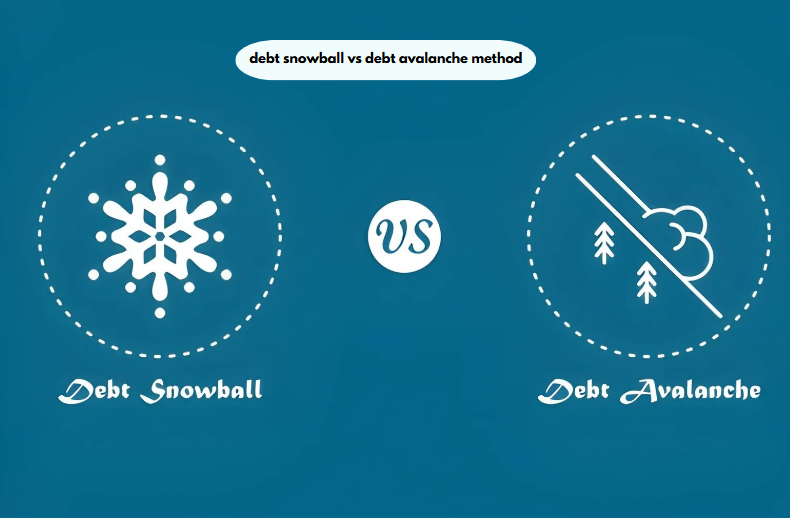
In the debt snowball vs debt avalanche method debate, the difference is simple. The avalanche pays off your highest-interest debt first and saves you more money. The snowball pays off your smallest balance first and gives you quicker wins. If you can stay disciplined, go avalanche. If you need early progress to stay motivated, go snowball.
The wider the gap between your highest and lowest interest rates, the more the avalanche saves. If your rates are only a few points apart, just pick the method you’ll stick with.
Key Takeaways
- The debt avalanche ranks debts by interest rate, highest first, and always produces the lowest total interest bill.
- The debt snowball ranks debts by balance, smallest first, and usually clears the first account months sooner.
- In a four-debt example with a $900 monthly budget, the avalanche saved $752 in interest and finished one month earlier.
- Spending the payment freed up by a paid-off debt cost more in that same example than choosing the “wrong” method.
- Neither plan works while new charges keep landing on the cards you are paying down.
What Are the Debt Snowball and Debt Avalanche Methods?
Both are payoff plans in which you pay the minimum on every debt and push all extra cash toward one target account, with the snowball targeting the smallest balance and the avalanche targeting the highest APR.
When the target hits zero, its full payment rolls onto the next debt in line. That rollover makes the monthly attack grow, and it powers both plans equally. Neither plan is better for every household; your rate spread and your history with budgets decide which one fits.
| Debt Snowball | Debt Avalanche | |
| Ranks debts by | Smallest balance | Highest APR |
| Total interest | Higher | Lowest possible |
| First debt paid off | Sooner | Later |
| Best for | People who need early wins | People who stay disciplined |
How Does Each Method Work, Step by Step?
Both methods use the same five steps, and only the ranking in step 3 changes. Everything else stays identical.
- List every debt with its balance, APR, and minimum payment. Leave your mortgage off the list.
- Choose one fixed monthly amount for debt that sits above the sum of your minimums.
- Rank the list. Snowball puts the smallest balance on top; avalanche puts the highest APR on top.
- Pay the minimum on everything, then send every leftover dollar to the top debt.
- Once the top debt reaches zero, add its whole payment to the next target and keep your monthly total unchanged.
Automate step 4. Setting up a scheduled payment in your bank’s app takes about five minutes, and this kind of simple tech removes the monthly urge to skip a payment.
Debt Snowball vs Debt Avalanche Method: Which Costs Less in Interest?
The avalanche always costs less money in interest, because each extra dollar goes toward the most expensive balance first. The size of that savings depends on how far apart your interest rates sit.
Card rates show the stakes. Banks charged an average 22.36% APR in August 2026 on credit card accounts that carried a balance, versus 21.19% across all card accounts, according to the Federal Reserve’s G.19 Consumer Credit release. The higher figure applies if you carry a balance, since the lower one also counts cardholders who paid no interest at all. At 22.36%, a $9,800 balance adds roughly $183 in interest every month.
A worked example with four common debts
With a $900 monthly budget, the avalanche trimmed total interest by $752 and finished one month sooner than the snowball. The four debts below total $23,300, and their minimums add up to $640, which leaves $260 of extra firepower each month.
The math follows the same rules we use for every money betterthisworld calculation: fixed minimum payments, monthly compounding, and zero new charges.
| Debt | Balance | APR | Minimum | Paid off (Snowball) | Paid off (Avalanche) |
| Personal loan | $1,800 | 11.0% | $60 | Month 6 | Month 31 |
| Credit card A | $4,500 | 24.9% | $115 | Month 18 | Month 14 |
| Car loan | $7,200 | 8.5% | $220 | Month 24 | Month 33 |
| Credit card B | $9,800 | 21.9% | $245 | Month 34 | Month 31 |
| Totals | $23,300 | $640 | |||
| Total interest paid | $6,626 | $5,874 |
Under the avalanche, the personal loan ranks third by rate, so it gets only minimum payments until month 31.
Why is the savings gap smaller than people expect?
The two cards here sit only three points apart, so ranking them by size barely changes the bill. Spread across 34 months, $752 equals about $22 a month.
Run a quick check on your own list: multiply the rate gap by the balance the snowball delays, then divide by 12. A 16-point gap on a $4,500 card costs about $60 a month while it waits; a 3-point gap costs about $11.
If you’re figuring out how to get out of debt fast, remember that payment size moves the finish line more than order does. Adding $100 a month to the avalanche budget here cuts payoff from 33 months to 29 and saves another $924.
Which Method Keeps You Motivated Longer?
The snowball wins on motivation because it produces a visible payoff early. In the example, it closed the first account in month 6, while the avalanche needed 14 months.
Eight months is a long wait for any real evidence.
People abandon debt plans when progress feels invisible, and a zero balance on a statement is the clearest evidence a plan works. If you have quit a budget before, that early win protects more money than $22 a month ever could, because a finished plan beats a cheaper one you abandon.
The rollover leak: a mistake that costs more than picking the wrong method
The costliest error is spending the payment on a cleared debt that frees up instead of rolling it forward. It happens because a paid-off loan feels like a raise, so the old $60 or $115 drifts toward takeout, streaming, or gaming subscriptions.
Rerun the example with that leak, and the snowball stretches from 34 months to 45. Interest climbs to about $7,750, which is $1,123 more than the disciplined snowball and $1,876 more than the avalanche.
The fix takes two minutes. On the day a debt hits zero, raise the scheduled payment on your next target by the exact amount you just freed, before that cash ever settles in checking. The rule is simple: your monthly total never shrinks until the last balance does.
How Can You Speed Up Either Plan?
Find extra cash and send every dollar of it to the current target. A bigger payment shortens either plan faster than any change in ranking.
Americans owed $1.26 trillion on credit cards at the end of June 2026, according to the Federal Reserve Bank of New York’s Household Debt and Credit Report. Shrink your share of it by hunting for dollars in this order:
- Send windfalls such as tax refunds and work bonuses straight to the current target.
- Cancel recurring charges you no longer use, including unused apps, streaming services, and memberships.
- Call your card issuer and request a lower APR; a one-point cut on a $9,800 balance saves about $98 a year.
- Add side income and route every dollar of it to debt.
Many of the passive income ideas that work for most households start small, such as renting out unused storage or selling printable templates. Whatever you earn, send it straight to your target balance before it reaches checking.
When Should You Ignore Both Methods?
Break the ranking, and set aside generic payoff tips whenever a deadline carries a penalty bigger than any interest gap. A store card with a deferred-interest promotion charges all the back interest if even $1 remains when the promo ends, so clear it before that date even if it is neither the smallest balance nor the highest rate. Federal student loans enrolled in a forgiveness or income-driven program are another exception, since extra payments reduce a balance the program would otherwise forgive.
Frequently Asked Questions
Does the debt snowball or avalanche help your credit score more?
Neither method helps your score more by itself; lower card balances relative to their limits do the real work. When your targets are credit cards, both plans improve utilization as balances fall, and keeping paid-off cards open preserves your available credit.
Can you switch from the snowball to the avalanche partway through?
Yes, you can switch at any point without penalty. Plenty of people grab one or two quick snowball wins, then re-rank the remaining debts by APR to cut interest.
Should you build an emergency fund before using either method?
Yes, keep a small cash cushion first so one surprise bill does not land back on a card. A starter fund of $1,000 to one month of expenses covers common repairs while most cash still flows to debt.
How long does the debt snowball take to finish?
Your timeline depends on total debt and how much you pay above the minimums. The four-debt example in this guide took 34 months at $900 a month and 30 months at $1,000.
Should a mortgage be included in the debt avalanche?
Usually no, because mortgage rates tend to sit far below card and personal loan rates. Clear consumer debts first, then weigh extra mortgage payments against saving or investing.
Conclusion
The debt snowball vs debt avalanche method decision matters less than most debates suggest: the avalanche wins on cost, the snowball wins on momentum, and the gap often runs near $20 a month. What actually sets your payoff date is a fixed monthly total that never shrinks until every balance reads zero.
This article is for educational purposes and isn’t personalized financial advice. Your results will depend on your rates, balances, and payment amounts.