
Financial literacy is the practical skill of earning, spending, saving, borrowing, and investing money so each choice supports your long-term goals. If you have ever asked what is financial literacy and why does it matter , the answer pays off fast: seven learnable skills cut debt costs, build emergency savings, and ease money stress.
Key Takeaways
- Financial literacy combines knowledge with habits, so knowing a rule without acting on it does not count.
- A written budget, a cash cushion, and a debt payoff plan form the base of every other money skill.
- Paying only slightly above the minimum on a high-interest credit card can more than double the time and interest needed to clear it.
- An employer 401(k) match is free money and delivers an instant return no other investment can match.
- Money stress drops when you replace vague worry with three numbers you check every week.
What Is Financial Literacy?
Financial literacy is the ability to understand how money works and to apply that understanding to real decisions about income, spending, credit, risk, and investing.
It goes beyond vocabulary. A person who can define “APR” but still carries a card balance every month has the knowledge without the skill.
What Is Financial Literacy and Why Does It Matter for Your Wallet?
It matters because money decisions compound. A habit that costs $50 a month looks harmless, yet over a decade it adds up to $6,000 in lost cash before any investment growth.
U.S. adults answered 49% of the questions correctly on the 2025 TIAA Institute-GFLEC Personal Finance Index, the same score as in 2017. On that 28-question test, the average adult gets about 14 wrong. The weakest areas include insurance, risk, and borrowing, which is where costly surprises usually hit.
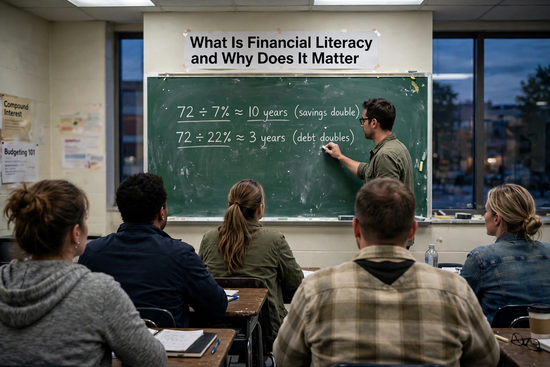
Interest cuts both ways, and the Rule of 72 makes that clear. Divide 72 by the rate to see roughly how long money takes to double. At a 7% investment return, savings double in about 10 years. At a 22% card rate, unpaid debt doubles in just over 3.
Gaps like these are exactly why the betterthisworldcom website focuses on money skills you practice, not facts you memorize, so readers turn knowledge into real results.
What Are the 7 Financial Literacy Skills Everyone Should Know?
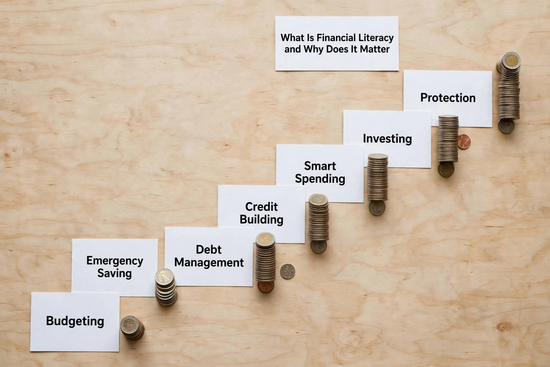
The seven core skills are budgeting, emergency saving, debt management, credit building, smart spending, investing, and protection. Learn them in roughly this order, because each one makes the next easier.
- Budgeting. Track take-home pay for one full month, then give every dollar a job. A zero-based budget suits tight incomes. The 50/30/20 split (needs, wants, savings, and debt) suits steadier ones.
- Emergency saving. Keep a starter fund of $1,000 in a separate high-yield savings account, then build toward three to six months of essential expenses.
- Debt management. List every debt by rate. The avalanche method pays off the highest rate first and saves the most interest. The snowball method tackles the smallest balance first, so motivation builds faster.
- Credit building. Pay every bill on time and keep card balances below 30% of each limit, ideally under 10%. Payment history and utilization drive most of a FICO score.
- Smart spending. Wait 48 hours before any unplanned purchase over $100, and convert the price into hours of work at your hourly wage.
- Investing. Capture your full employer match first. If you earn $60,000 with a 50% match on up to 6% of pay, putting in $3,600 a year gets you $1,800 free.
- Protection. Carry health, auto, and renters or homeowners insurance. Add term life insurance if anyone depends on your income, and freeze your credit at Equifax, Experian, and TransUnion at no cost.
Emergency savings is the skill most households lack. In the Federal Reserve’s Economic Well-Being of U.S. Households in 2025 report, 63% of adults said they would cover a surprise $400 expense with cash or its equivalent. That means about 37% would need to borrow, sell something, or leave the bill unpaid, which is why the $1,000 starter fund comes before extra debt payments.
How Much Does a Credit Card Balance Really Cost?
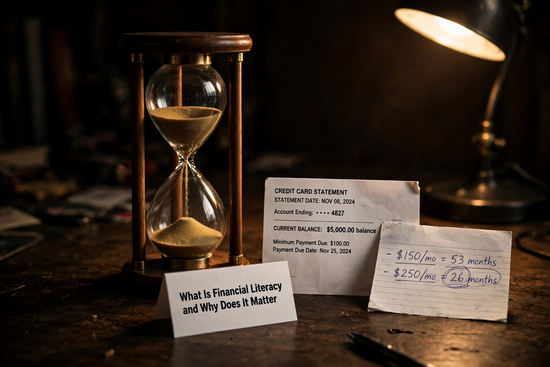
Usually far more than people guess. The worked example below assumes a $5,000 balance, no new charges, and a fixed monthly payment.
| Monthly payment on $5,000 | Months to pay off | Total interest paid | Rate used | Source |
| $150 | 53 | $2,886 | 22.36% APR | Federal Reserve G.19 Consumer Credit, August 2026 data |
| $250 | 26 | $1,315 | 22.36% APR | Federal Reserve G.19 Consumer Credit, August 2026 data |
| $500 | 12 | $585 | 22.36% APR | Federal Reserve G.19 Consumer Credit, August 2026 data |
Raising the payment from $150 to $250 saves $1,571 and puts you debt-free 27 months sooner.
The common mistake is treating the minimum payment as the “right” payment. Issuers set it low, so interest keeps running for years. The fix: set up an automatic payment for a fixed dollar amount, raise it by $25 after every pay increase, and ask your issuer for a lower rate, since a single phone call costs nothing.
That is why every money betterthisworld guide on debt starts with one simple, proven rule: your monthly payment matters more than the size of the balance you start with.
How Can You Tell If You Are Overspending?

Your savings balance falls month after month, your card balance never hits zero, or your paycheck is gone before payday. Any one of these means your spending has outpaced your income.
Run three quick ratio checks to spot the less obvious signs you are living beyond your means:
- Housing: If housing tops 30% of gross income, everything else gets squeezed.
- Debt payments: If non-mortgage debt payments pass 15% to 20% of take-home pay, saving gets pretty hard.
- Savings rate: Saving under 10% of take-home pay usually means wants are crowding out your goals.
Behavior gives you away too. Using a card for groceries, relying on buy-now-pay-later plans for routine items, or skipping a retirement contribution to cover a bill all point to the same gap.
Which Daily Habits Quietly Drain Your Money?
The costliest ones are forgotten subscriptions, long loans on things that lose value, and spending that climbs with every raise. Each drains cash slowly enough that you stop noticing.
In a December 2025 survey by the National Financial Educators Council, adults estimated that gaps in money knowledge cost them $948 on average that year. That comes to about $79 a month. Put into a retirement account earning a 7% average annual return, $79 a month grows to roughly $13,700 in ten years.
Three toxic money habits keeping you poor (and the Easy Fix for Each)
- Subscription creep: Audit bank statements line by line every quarter and cancel anything unused for 30 days.
- Long auto loans: Cap car loans at 48 months, since 72-month terms often leave you owing more than the car is worth.
- Lifestyle inflation: Send at least half of every raise straight to savings before it reaches checking.
How Do You Calm Money Stress?

Turn vague fear into a few concrete numbers, then take one small action each week. Avoiding your accounts feeds the worry, and looking at them takes away its power.
Schedule a 20-minute money check every Sunday. Record three figures only: your checking balance, total debt, and savings balance. If you are wondering how to overcome financial anxiety, this weekly habit is one of the most reliable places to start, because watching those three numbers improve replaces worry with visible progress.
Then choose one task for the week, such as moving $25 to savings, canceling one subscription, or calling a lender. If stress feels unmanageable, a nonprofit credit counselor accredited by the NFCC offers free budget reviews.
When the usual advice does not apply: standard budgets assume steady paychecks, so they fail freelancers, gig drivers, and seasonal workers. If your income swings more than 25% from month to month, budget around your lowest-earning month from the past year. Send every dollar above that floor to savings until you hold three months of baseline expenses.
Frequently Asked Questions
What are the 5 basic principles of financial literacy?
The five basic principles are earning, saving, spending, borrowing, and protecting money. Many frameworks add investing as a sixth. Together they cover every money decision a household makes.
At what age should you start learning financial literacy?
Children can start around age five with simple choices about saving and spending. Teens should learn budgeting, credit, and paycheck basics before their first job. Adults who start late still make fast progress, because the core skills take weeks, not years, to learn.
How much should I keep in an emergency fund?
Stash three to six months of must-pay bills in an emergency fund. Start with $1,000, then build toward the full target. Single-income and self-employed households should aim for six months or more.
Is financial literacy the same as being good with money?
No. Financial literacy is just knowing things; being good with money takes steady habits too. Automatic transfers and payments bridge that gap, putting what you know into action without needing willpower.
Should I pay off debt or invest first?
Capture any employer match first, then pay off debt, charging more than about 7% before investing more. A match pays an immediate return. Card interest above 20% beats almost any long-term investment return, so clearing it gives a guaranteed gain.
Conclusion
Asking what is financial literacy and why does it matter is the first step toward keeping more of every paycheck. The seven skills work as one system: budget first, protect yourself with cash, wipe out high-rate debt, and then let your investments compound. One concrete action this week beats a perfect plan that never starts.