

If you’re wondering how to budget for Christmas on a low income, cover rent, food, and utilities first. Then pick a set holiday amount from leftover cash, never credit. Divide it between gifts, food, and extras, pay with cash or debit, and stop spending when each envelope is empty.
Key Takeaways
- A low-income Christmas budget pays rent, food, utilities, transportation, and minimum debt payments first, and the holiday gets only what remains.
- Capping holiday spending at half of your leftover cash keeps a buffer for January bills.
- Free toy programs and bill discounts stretch a small budget further than any sale.
- A holiday credit card balance costs months of interest after the gifts are opened.
What Is a Low-Income Christmas Budget?
A low-income Christmas budget simply means setting a limit on gifts, food, and decorations, paid only with money left over after bills, with no borrowing.
How Much Should You Spend on Christmas on a Low Income?
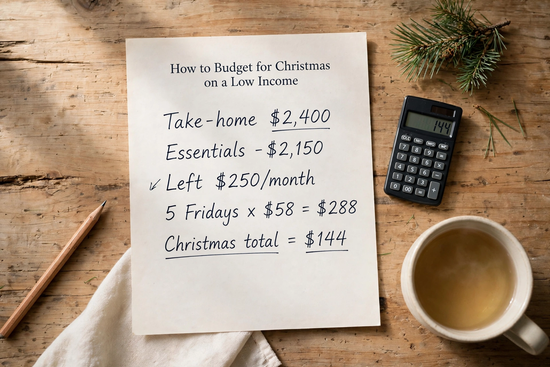
Spend no more than half of the cash left after essentials between now and December 20. That number is your ceiling.
Shoppers planned to spend $890.49 per person on gifts, food, decorations, and other seasonal items for the 2025 holidays, according to the National Retail Federation’s annual consumer survey. For a household with $250 spare each month, matching it for one person eats over three and a half months of slack. In NRF’s 2026 survey, 56% of holiday shoppers said the economy will affect their holiday spending plans this year.
A Worked Example for a $2,400-a-Month Household
Picture a family of four, two adults and two kids, taking home $2,400 a month. Rent, groceries, utilities, transportation, and minimum debt payments take $2,150, leaving $250.
That equals about $58 a week. As of mid-November, five Fridays remain before December 20, so the family holds roughly $288 in free cash, and half of it, $144, becomes the Christmas total:
- Gifts: $79, about $30 per child plus $19 for a family gift swap
- Holiday meal: $50
- Wrapping, cards, and small extras: $15
The other $144 stays in checking for January heating bills. Splitting leftover cash in half is one of the most reliable simple budgeting tips for beginners, since it works at any income.
How to Budget for Christmas on a Low Income: 12 Practical Tips
Follow these tips in order: the first five set your limits, and the rest help you stay inside them.
- Pay essentials first. Rent, food, utilities, and minimum debt payments come off the top.
- Write down one total. A single number on paper gives every later choice a yardstick.
- Split it into three envelopes. Use cash or labeled bank sub-accounts, and never raid one to refill another.
- Give every name a dollar cap. No number means a card, not a purchase.
- Shrink the gift circle. Propose a $15 Secret Santa for adults or a kids-only rule before anyone shops.
- Buy the main gift first. Lock in each child’s top request early.
- Wait 48 hours on anything unplanned. A parked cart cools most urges, and it’s the easiest first step in learning how to stop impulse buying and save money.
- Remove the easy buttons. Delete saved cards and unsubscribe from retailer emails.
- Compare two stores minimum. A Black Friday ad must beat your best price.
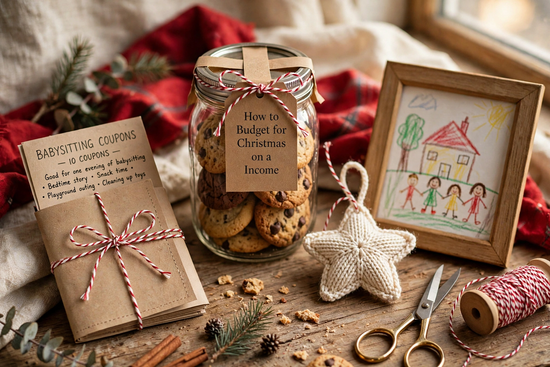
- Give time and skills. Babysitting coupons or homemade tamales cost little.
- Cook from your pantry. Build the holiday meal from food you already own.
- Start next year’s fund on January 2. Moving $5 a week into separate savings builds about $250 by the following December.
How Can You Free Up Extra Cash Before Christmas?

Trim one or two recurring bills now and send every saved dollar to the holiday envelopes.
Every bill you trim becomes Christmas money that never touches rent, which is why knowing how to reduce monthly expenses matters more in November than any sale. Pausing two $15 streaming services through January frees $30 a month. Ask your internet provider about low-income plans, and check whether SNAP or Medicaid enrollment qualifies you for the federal Lifeline phone discount. Selling outgrown kids’ clothes or baby gear online adds quick cash.
Store each receipt with its return policy info in one phone folder so an unused gift becomes a January refund.
What Does Holiday Debt Cost a Low-Income Household?
Holiday debt costs more than the price tags, because the bills land in January, when hours often drop and heating costs peak.
In the 2025 season, 37% of consumers took on holiday debt, averaging $1,223, according to LendingTree’s annual holiday debt survey. Saved across 52 weeks instead, that same sum needs just $23.52 a week starting in January.
The BetterThisWorld table below turns national averages into weekly savings targets you can actually use.
| Holiday benchmark | Amount | Weekly saving over 52 weeks | Weekly saving over 6 weeks | Source |
| Planned gift spending per person, 2025 | $627.93 | $12.08 | $104.65 | National Retail Federation and Prosper Insights & Analytics |
| Planned food, decorations, and cards per person, 2025 | $262.56 | $5.05 | $43.76 | National Retail Federation and Prosper Insights & Analytics |
| Average holiday debt, 2025 season | $1,223 | $23.52 | $203.83 | LendingTree |
| Average holiday debt, earners of $30,000 to $49,999, 2024 season | $909 | $17.48 | $151.50 | LendingTree |
| Average holiday debt, parents of children under 18, 2025 season | $1,324 | $25.46 | $220.67 | LendingTree |
The spending rows show plans made before the season; the debt rows show balances reported after it. Starting six weeks out makes every weekly target almost nine times larger than starting in January. A household earning $30,000 to $49,999 that starts today would need about $151 a week to cover that group’s average holiday debt in cash.
Should You Put Christmas on a Credit Card?

No, unless you can pay the full statement balance by its due date.
Card accounts carrying a balance paid an average rate of 22.36% in August 2026, according to the Federal Reserve’s G.19 Consumer Credit release. At that rate, a $1,223 holiday balance paid down at $150 a month takes nine months and adds about $116 in interest. Cut the payment to $100, and the payoff stretches to 15 months with roughly $178 in interest, so this Christmas would still be on your statement in March 2028.
One of the BetterThisFacts worth remembering this season: interest turns a $1,223 Christmas into roughly $1,339 to $1,401.
Where Can Low-Income Families Get Free Christmas Help?

Call 211, the free United Way referral line, to find toy drives and food bank holiday boxes in your county.
Most local Toys for Tots campaigns serve children up to age 12, though some sites extend the limit, according to the Marine Toys for Tots program’s local campaign FAQs. Check your county’s cutoff and deadline today, and ask the Salvation Army Angel Tree or a school counselor about teens. Some libraries and fire stations also host a free community toy event in December.
When Should You Skip a Christmas Budget Entirely?
Skip it when an essential bill is already overdue. If you face late rent, a utility shutoff notice, or skipped meals, your holiday total is zero: every spare dollar goes to that bill, your state’s Low Income Home Energy Assistance Program office handles heating aid, and charity covers gifts this year.
Frequently Asked Questions
How much should a low-income family spend on Christmas?
Keep the holiday total at or below half of the money left after essentials before December 20. With $58 a week to spare and five weeks left, that lands near $144.
Can I still get free Christmas toys if I missed the deadline?
Often yes, since some churches, libraries, and fire stations run walk-in giveaways with no application. Call 211 and ask for December toy distributions near your ZIP code.
Is buy now, pay later a good idea for Christmas gifts?
Buy now, pay later rarely helps a tight budget, because it pushes holiday costs into January and February paychecks. Stacked plans make due dates easy to miss.
How do I tell my family I can’t afford gifts this year?
Tell them early and plainly, with an alternative ready, such as a $15 gift swap or a shared homemade meal. Sending it before Thanksgiving lets relatives adjust their lists.
What is the cheapest way to host Christmas dinner?
Host a potluck where each guest brings one dish, and cook a low-cost main like roast chicken or chili. Food banks often hand out free holiday meal boxes.
Conclusion
Knowing how to budget for Christmas on a low income comes down to one order of operations: essentials first, a written cash total second, and gifts last. A smaller holiday paid in full beats a bigger one that follows you into spring. Start a $5 weekly fund in January, and next December opens with about $250 already saved.