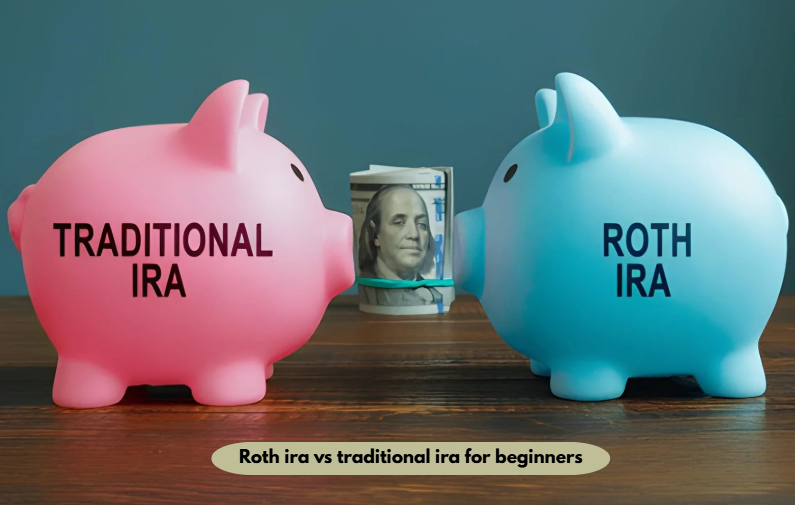
Roth IRA vs Traditional IRA for beginners comes down to one thing: when you pay tax. A Roth taxes you now, so retirement withdrawals are tax-free. A traditional IRA flips that: deduct now, pay later. Beginners in low tax brackets usually gain more from a Roth.
Key Takeaways
- A Roth IRA is funded with money that has already been taxed, and qualified withdrawals in retirement are tax-free.
- A traditional IRA can lower this year’s taxable income, and every dollar withdrawn in retirement is taxed as ordinary income.
- Both account types share one annual contribution limit, so money put into one reduces the room left in the other.
- Roth contributions have an income ceiling, while the traditional IRA deduction shrinks only for savers who also have a retirement plan at work.
- An IRA is only a container, and the money grows only after it is invested in funds or other assets.
What is an IRA?

An IRA, or individual retirement arrangement, is a personal account that shelters long-term investments from yearly taxes and is opened by an individual at a brokerage or bank instead of through an employer.
What is the difference between a Roth IRA and a traditional IRA?
The two accounts tax the same money at opposite ends of your career: a traditional IRA taxes it at withdrawal, and a Roth taxes it before it goes in. Everything else, from income limits to withdrawal rules, follows from that one split.
| Feature | Roth IRA | Traditional IRA | Source |
| When you pay tax | Before you contribute | When you withdraw | General tax rule |
| Annual contribution limit (under age 50), 2026 | $7,500 | $7,500 | IRS, 2026 cost-of-living adjustments |
| Extra contribution at age 50 or older, 2026 | $1,100 | $1,100 | IRS, 2026 cost-of-living adjustments |
| Income phase-out, single filer, 2026 | $153,000 to $168,000 limits who can contribute. | $81,000 to $91,000 limits the deduction if you have a workplace plan. | IRS, 2026 cost-of-living adjustments |
| Income phase-out, married filing jointly, 2026 | $242,000 to $252,000 limits who can contribute. | $129,000 to $149,000 limits the deduction if the contributing spouse has a workplace plan | IRS, 2026 cost-of-living adjustments |
| Taking contributions out before age 59½ | Allowed anytime, no tax or penalty | Taxed, plus a 10% penalty in most cases | General tax rule |
Read the income rows closely, because they measure different things. The Roth ranges decide whether you are allowed to contribute at all, while the traditional ranges only reduce the deduction, and only for people covered by a retirement plan at work.
Traditional accounts are still more common, held by 33% of U.S. households versus 28% for Roth accounts in mid-2025, according to the Investment Company Institute’s 2025 IRA report. Popularity is a weak guide for a first account, since many traditional IRAs began as a rolled-over 401(k) and not as a fresh choice.
Roth IRA vs traditional IRA for beginners: which one saves more tax?
The account that saves more tax is the one that taxes your money at the lower rate. A Roth wins when your bracket today is lower than your bracket in retirement, and a traditional IRA wins when it is higher.
A worked example with $6,000 of pay
With equal tax rates the two accounts finish exactly tied, and a gap opens only when the rates differ. Take $6,000 of pre-tax pay, a 12% bracket today, 30 years of investing, and an assumed 7% yearly return, which multiplies each dollar by about 7.61.
- Roth: pay $720 of tax now, invest $5,280, and end with about $40,193, all of it yours.
- Traditional, 12% bracket in retirement: invest the full $6,000, grow it to about $45,674, pay 12% on the way out, and keep $40,193. A tie.
- Traditional, 22% bracket in retirement: keep $35,626, which is $4,567 less than the Roth.
- Traditional, 10% bracket in retirement: keep $41,106, which is $913 more than the Roth.
For 2026, the 22% federal bracket begins at $50,400 of taxable income for a single filer, according to NerdWallet’s 2026 tax bracket tables. A beginner whose taxable income sits under that line pays 12% or less today, a rate that is hard to beat in retirement, so the Roth is the stronger pick.
How much can you put in an IRA in 2026?
You can contribute up to the annual limit or your earned income for the year, whichever is smaller. That limit covers all of your IRAs combined. The IRS set the 2026 limit at $7,500 in its November 2025 cost-of-living announcement.
Reaching that cap takes $625 a month, or about $288 from each of 26 biweekly paychecks. Contributions for 2026 are accepted until the tax filing deadline of April 15, 2027.
A recurring transfer scheduled for the day after payday is how to automate your savings easily, because the money leaves checking before it gets spent. Start with an amount you will not need to reverse, even $50 a month, and raise it with every pay increase.
What mistakes do beginners make when opening an IRA?
The most expensive beginner mistake is funding an IRA and never investing the money. The deposit then sits in a cash holding account for years, earning little, while the owner believes it is growing.
It happens because opening the account and moving money in feels like the finish line. These three errors cause the most damage, and each has a simple fix:
- Leaving deposits in cash. After every transfer, buy an investment. Individual stocks are allowed, but one broad index fund or target-date fund holds hundreds of stocks and spreads the risk.
- Comparing equal deposits. A $6,000 Roth deposit costs more take-home pay than a $6,000 deductible deposit, which returns $720 at tax time in the 12% bracket. The traditional IRA keeps pace only if that refund is invested too.
- Locking up short-term cash. Goals like how much money should I save before moving out, or how to increase your credit score quickly, sit one to three years away, so that money belongs in a savings account and not an IRA.
Budgeting information from any website, including popular searches like money betterthisworld, builds good habits, but only your own tax bracket settles the Roth-or-traditional question.
When does the Roth-first rule not apply?
The Roth-first rule breaks for a saver in a high bracket today who expects a much lower income in retirement, such as a late-career earner taxed at 24% or more; a deductible traditional contribution saves that person more. It also breaks for anyone above the Roth income range, who is barred from contributing directly. A third case is a worker with a 401(k) match: capture the full match before funding any IRA, because no IRA tax benefit equals an instant employer contribution.
Frequently Asked Questions
Can I have both a Roth IRA and a traditional IRA?
Yes, you can own both types at once, but your combined contributions cannot exceed the single annual limit. Splitting deposits between the two is allowed and hedges against not knowing your future tax rate.
Is a Roth IRA better than a traditional IRA for a 25-year-old?
For most 25-year-olds, a Roth IRA is the better choice because early-career income usually falls in a low tax bracket. The account also gets four decades of growth that will never be taxed.
Can I withdraw money from a Roth IRA early?
You can withdraw your Roth IRA contributions at any time without tax or penalty, but investment earnings are restricted. Earnings taken out before age 59½, or before the account has been open five years, are generally taxed and hit with a 10% penalty.
Do I need a lot of money to open an IRA?
No, many large brokerages let you open an IRA with no minimum deposit. A small monthly transfer is enough to start, and fractional fund shares let you invest the full amount.
Can I switch from a traditional IRA to a Roth IRA later?
Yes, a Roth conversion moves traditional IRA money into a Roth, and the converted amount is taxed as income that year. Converting during a low-income year shrinks the bill, and paying the tax from outside savings keeps the whole balance invested.
Conclusion
The Roth IRA vs traditional IRA for beginners question has a short answer: pay tax at the point in life when your rate is lowest. For most people starting out, that point is now, which makes the Roth the default first account. Open it, automate the deposit, and invest every dollar that lands.