
The toxic money habits keeping you poor are usually automatic: carrying card balances, paying minimums, skipping a budget, and spending every raise. Breaking them takes three moves, which are automating savings on payday, paying a fixed amount above the minimum, and assigning every dollar before the month starts.
Key Takeaways
- A credit card balance carried month to month is the costliest habit most households have, because card interest compounds monthly.
- Raising a fixed card payment from $150 to $300 on a $5,000 balance cuts payoff time from 53 months to 21 months.
- A zero-based budget assigns every take-home dollar to a category until income minus planned spending equals zero.
- Saving on payday works, while saving whatever is left at month-end rarely does.
- Investing $300 a month at an assumed 7% annual return grows to about $156,000 in 20 years.
What Are Toxic Money Habits?
Toxic money habits are spending, borrowing, or saving behaviors you repeat that drain your income faster than it grows, usually without any single purchase feeling like a mistake.
Toxic Money Habits Keeping You Poor: Which Ones Do the Most Damage?
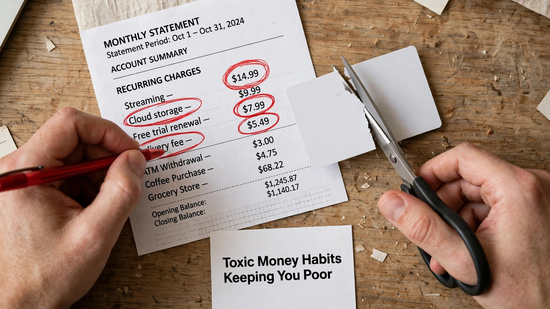
The worst habits run on autopilot. No single decision feels expensive, so the losses build up without you noticing.
Americans held $1.26 trillion in credit card balances in the second quarter of 2026, according to the Federal Reserve Bank of New York. Check your last three statements against these nine mistakes:
- Carrying a card balance. Interest makes every purchase cost more than its price.
- Paying only the minimum. Minimums mostly cover interest, so the principal barely moves.
- Spending without a written plan. Dollars without a job tend to go to impulse buys.
- Ignoring auto-renewals. Streaming apps, cloud storage, and forgotten free trials keep billing you quietly.
- Spending every raise. Lifestyle creep turns a bigger paycheck into bigger fixed costs.
- Skipping the emergency fund. Without cash reserves, every flat tire goes on a card.
- Defaulting to delivery. Service fees, tips, and markups can push a meal’s cost far above the menu price.
- Saving the leftovers. Savings made at month-end usually come to zero.
- Financing wants. Buy-now-pay-later plans and 72-month car loans make luxuries look like small payments.
For habit four, follow this simple rule from money betterthisworld: every 90 days, review each charge that renews automatically and cancel any you no longer use.
How Much Does Carrying a Credit Card Balance Really Cost?
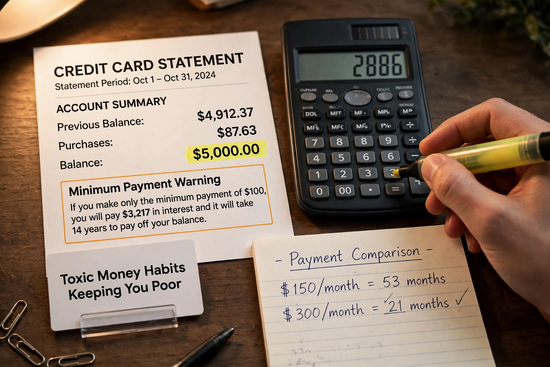
A carried balance costs roughly 1.9% of what you owe every month, which adds up to thousands of dollars over a typical payoff.
Credit card accounts that paid interest averaged a 22.36% APR in the third quarter of 2026, according to the Federal Reserve’s G.19 Consumer Credit release. On a $5,000 balance, that rate adds about $93 in the first month alone.
The payment you choose sets the final bill:
| Fixed monthly payment | Months to pay off $5,000 | Total interest paid | Total paid |
| $150 | 53 | $2,886 | $7,886 |
| $300 | 21 | $1,043 | $6,043 |
These figures assume a 22.36% APR and no new purchases.
Doubling the payment saves $1,843 and gets you out of debt 32 months sooner. Your statement already shows the information you need: the APR, the balance, and the “minimum payment warning” box, which shows how long paying only the minimum will take. If you have several cards, send extra money to the card with the highest APR first (the avalanche method) and pay the minimum on the rest.
Where Does a Typical Household’s Money Leak?
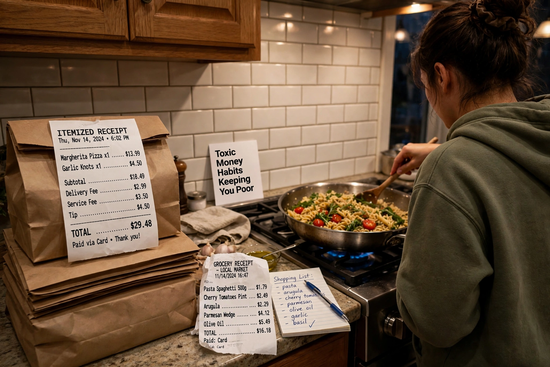
Most leaks hide in food away from home, subscriptions, and transportation.
Households spent an average of $4,142 on food away from home in 2025, according to the U.S. Bureau of Labor Statistics. That’s about $345 a month. Cut it in half and roughly $2,071 a year goes back into your account.
How do your numbers compare?
Housing, transportation, and food take up most of a typical budget. Put your own monthly figures next to these:
| Category | National average (2025) | Approximate monthly equivalent | Habit that inflates it | Source |
| Total annual spending | $81,905 | $6,825 | No written budget | U.S. Bureau of Labor Statistics |
| Housing | $27,790 | $2,316 | Renting or buying at your approval limit | U.S. Bureau of Labor Statistics |
| Transportation | About $13,500 (16.5% of spending) | About $1,126 | Long auto loans on new vehicles | U.S. Bureau of Labor Statistics |
| Food at home | $6,491 | $541 | Shopping without a list | U.S. Bureau of Labor Statistics |
If you’re learning how to reduce monthly expenses, start with two phone calls. Ask your car insurer for a new quote at a higher deductible, and ask your phone carrier about its current promotional plans. Then cancel every subscription you haven’t used in 30 days.
How Do You Build a Zero-Based Budget?
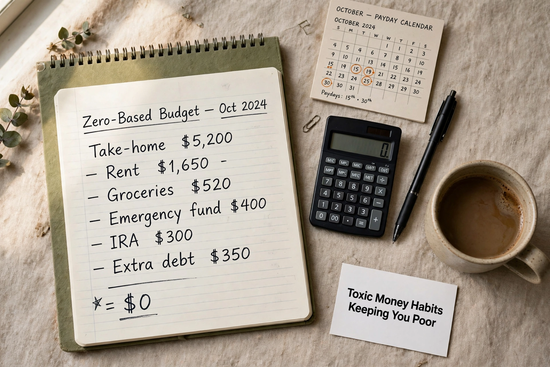
You give every dollar of take-home pay a job (bills, debt, savings, or spending) until income minus everything you’ve assigned equals zero. No money is left unassigned, so nothing slips away.
Here is how to do a zero based budget on $5,200 of monthly take-home pay:
- Start with net pay. Use the amount that actually lands in your account after taxes: $5,200.
- Fund fixed costs. Rent: $1,650; utilities: $220; insurance: $260; transportation: $480.
- Cover essentials. Groceries: $520 and minimum debt payments: $150.
- Pay goals before wants. Extra debt payment: $350; emergency fund: $400; IRA: $300.
- Spend the rest on purpose. Subscriptions: $45; dining out: $200; personal spending: $250; gifts: $100; buffer: $275. Total: $5,200.
Redo the plan before each month begins.
Why Does an Emergency Fund Protect Every Other Habit?
Cash reserves keep surprise bills from turning into new card debt. Without them, one car repair can wipe out months of budgeting.
The Federal Reserve’s Economic Well-Being of U.S. Households in 2025 report found that 63% of adults would handle a surprise $400 expense using cash or its equivalent. That leaves roughly 37% who would borrow, sell something, or fall behind. If you’re in that group, schedule a $25 transfer every payday into a separate high-yield savings account. After 26 paydays, you’ll have $650 set aside.
Knowing how to manage money effectively mostly means taking willpower out of the process. Schedule transfers for the morning your paycheck arrives, not the night before rent is due.
What Habits Should Replace the Toxic Ones?

Replace each automatic drain with an automatic deposit.
These three smart money habits to build wealth do most of the work:
- Invest on a schedule. At an assumed 7% average annual return, $300 a month grows to about $51,900 after 10 years and $156,300 after 20, from $72,000 in contributions.
- Split every raise. Send half of each raise to savings or retirement before your spending catches up with it. A $4,000 raise then adds $2,000 a year to your net worth.
- Wait 24 hours before any online purchase over $100. A one-day pause filters out most impulse buys.
One exception overrides the “pay off debt first” rule. If your employer matches 401(k) contributions, contribute enough to get the full match, because an instant 50% or 100% return beats any card’s APR. Gig workers and others with irregular pay also do better saving one month of expenses in cash before making extra debt payments, since a slow month will otherwise push them straight back onto the card.
Frequently Asked Questions
What is the most damaging money habit?
Carrying a credit card balance does the most damage for most households. Interest compounds monthly, so every purchase ends up costing more than its sticker price.
How do I stop living paycheck to paycheck?
Build a small cash cushion first, then plan every dollar before the month starts. Having half a month’s expenses in savings goes a long way toward ending the cycle of borrowing between paychecks.
Which habits help you build wealth over time?
Paying yourself first, investing automatically, and keeping fixed costs low build wealth over time. Raise your retirement contributions by 1% each year so the increase never feels like a pay cut.
Is paying only the minimum on a credit card bad?
Yes, because minimum payments keep you in debt for years and multiply the interest you pay. Switch to a fixed payment and send windfalls, such as tax refunds, straight to the balance.
How often should you review your budget?
Review it every month before the month starts, and check your spending once a week. The weekly check catches overspending while there’s still time to adjust, so tie it to a set day, like Sunday evening.
Conclusion
The toxic money habits keeping you poor rarely show up as one big mistake. They slip in through minimum payments, forgotten renewals, and raises that vanish into new bills. Replace each drain with an automatic deposit, and your paycheck starts building wealth instead of paying interest.



2 Comments on “Toxic Money Habits Keeping You Poor: 9 Mistakes to Break Before They Cost You More ”