

In the US, to learn how to use a credit card responsibly to build credit, charge only small, planned purchases, pay the full statement balance by each due date, and keep reported balances under 10% of your limit. Paying in full builds the same on-time history as carrying a balance, minus the interest.
Key Takeaways
- Payment history matters more to your credit score than anything else, which means a single missed due date can undo months of careful spending.
- Paying the full statement balance counts as an on-time payment, which means building credit never requires paying interest.
- Most issuers report the balance from your statement closing date, so a payment made before that date lowers the utilization lenders see.
- Card issuers generally report a missed payment once it reaches 30 days past due, and the mark stays on your credit report for up to seven years.
- Keeping your oldest no-fee card open protects your average account age and your total available credit.
What Is Responsible Credit Card Use?
Responsible credit card use means treating the card as a payment channel for cash already sitting in your checking account, then paying the full statement balance on time so the issuer sends low-balance, never-late payment information to the three national credit bureaus.
How to Use a Credit Card Responsibly to Build Credit?
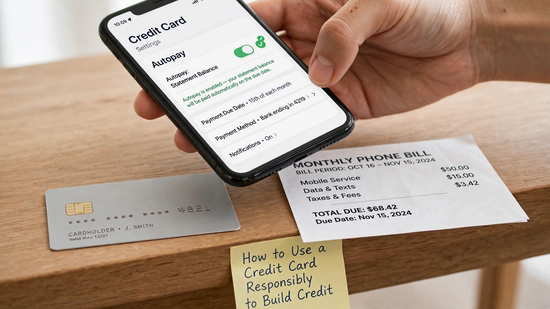
You build credit with a card by stacking up months of on-time payments while the balance the bureaus see stays small. Six habits get you there without a cent of interest.
- Choose one no-annual-fee starter card. A secured card, a student card, or a basic cash-back card from your own bank all report to the bureaus, and a $0 fee lets you keep the account open for decades.
- Give it one recurring bill. A phone plan or streaming subscription keeps the card active every month without inviting impulse spending.
- Set autopay to “statement balance.” The minimum-payment option prevents late marks but quietly starts interest; the statement-balance option prevents both. Add your current phone number and email so payment-alert info reaches you before a due date slips.
- Locate your statement closing date. It prints on every statement, roughly three weeks before the due date, and it decides which balance gets reported.
- Keep the closing balance under 10% of the limit. On a $1,000 limit, that ceiling is $100 on the statement date.
- Leave the account open as it ages. Account age keeps growing while the card stays open, so your first card becomes your most valuable one over time.
The dividing line is simple. Charges your checking account already cover build credit; charges it cannot cover build debt.
Which Credit Card Mistakes Damage Your Score Most?
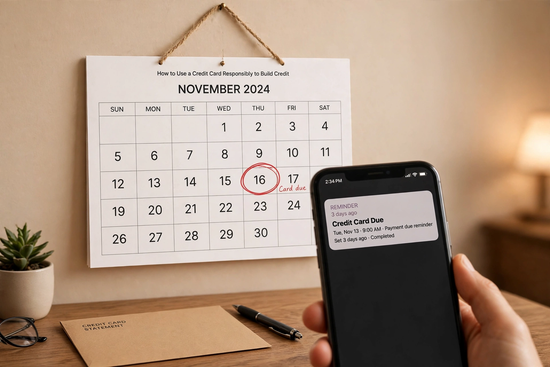
A payment that slips 30 or more days past due does the deepest damage, and high reported balances come second. Both map directly onto the two heaviest categories in the scoring formula.
If you want to know what hurts your credit score the most, the answer is timing: watch the calendar before you watch the balance. A missed autopay caught within a few days usually costs only a late fee, while the same mistake left alone for a month becomes a seven-year entry on your report.
| Scoring factor | Share of score | What damages it | Habit that protects it | Source |
| Payment history | 35% | Payments 30+ days late, collections | Full-balance autopay plus a calendar alert | myFICO, What’s in my FICO Scores? |
| Amounts owed | 30% | High statement balances relative to limits | Paying before the statement closes | myFICO, What’s in my FICO Scores? |
| Length of credit history | 15% | Closing your oldest card | One small recurring charge on the starter card | myFICO, What’s in my FICO Scores? |
| New credit | 10% | Several applications in a short span | Spacing applications at least six months apart | myFICO, What’s in my FICO Scores? |
| Credit mix | 10% | Rarely an issue for beginners | Letting installment loans arrive when you actually need them | myFICO, What’s in my FICO Scores? |
The top two rows add up to 65% of the score, and you control both inside a single billing cycle. Set a phone reminder three days before each due date as a backup to autopay.
Does Carrying a Balance Help Your Credit Score?
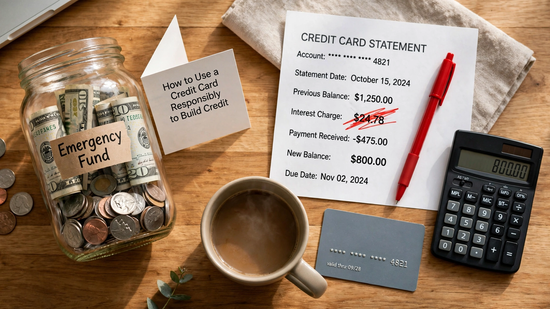
No. Scoring models record whether you paid on time and how large your statement balance was, not whether you paid in full or rolled part of it forward.
Banks charged an average APR of 22.36% on card accounts that incurred interest during the third quarter of 2026, according to the Federal Reserve’s G.19 Consumer Credit release. That rate counts only accounts that actually paid finance charges, so it reflects what revolvers pay rather than the advertised rate on cards whose owners clear the bill each month.
Carry $1,500 at that rate, and the first month’s interest runs about 28 (1,500 × 0.2236 ÷ 12). Hold the same balance for a full year, and roughly $335 disappears, with zero effect on your score. Redirect that money into an emergency fund, and the next car repair never touches the card.
When Should You Pay Your Credit Card to Lower Utilization?
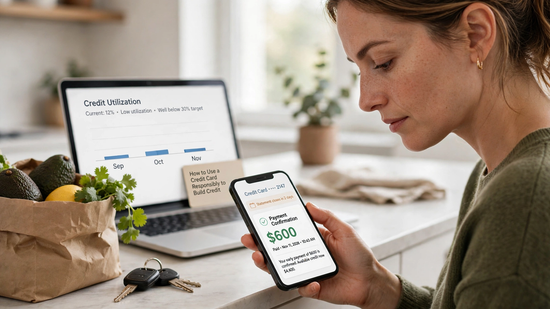
Pay before the statement closing date, then pay any remainder by the due date. Issuers typically report the closing balance, so a large charge paid off on the due date still shows up as high utilization.
The Statement-Date Mistake, With Real Numbers
This error catches careful people, because they never pay interest and assume their reported usage is zero.
Picture a cardholder with a $1,000 limit who puts $650 of groceries and gas on the card each month and pays in full on the due date. Her statement closes at $650, so the bureaus see 65% utilization every single month. The fix costs nothing: she sends $600 through the issuer’s app two days before closing, the statement posts at $50, and her reported utilization drops to 5% with identical spending and identical zero interest.
Consumers with credit scores of 800 or higher averaged 7% utilization as of June 2026, compared with 29% for all consumers, according to Experian data. The first number describes top scorers only, while the second blends everyone, including people with maxed-out cards. On a $2,000 limit, matching the top-scorer average means a statement balance near $140; the all-consumer average equals $580.
Do Credit Limit Increases Help?
Yes, a higher limit lowers utilization automatically, as long as spending stays flat. A $150 statement balance equals 15% of a $1,000 limit but only 7.5% of a $2,000 limit.
Before requesting an increase, ask the issuer whether the review uses a hard inquiry. A soft-pull increase leaves your report untouched, which makes it the better choice when an issuer offers both routes.
How Long Does It Take to Build Credit With a Credit Card?
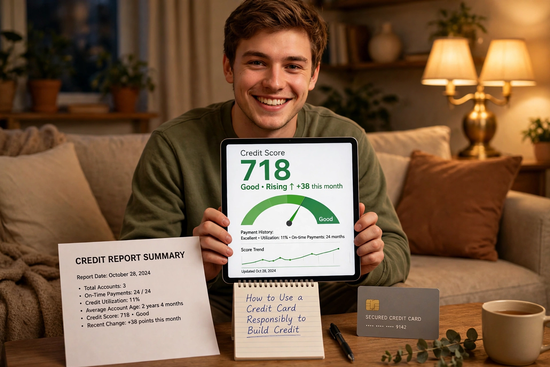
A brand-new file usually generates its first FICO score after about six months of reported activity, though some VantageScore models can score you sooner. Strong scores take longer, because the length-of-history factor keeps rewarding the account as it ages.
For a new credit file, the most effective credit score improvement tips are also the least exciting: autopay every month, small closing balances, and no new applications for at least six months. Judge each month by behavior rather than points: autopay ran, the closing balance stayed small, and nothing new hit your report.
If no issuer approves you yet, a secured card backed by a $200 to $500 deposit beats waiting, since it reports exactly like a regular card and usually graduates to an unsecured account after a year of clean payments.
Check all three reports at least once a year through AnnualCreditReport.com, the federally authorized free-report website. Dispute any error directly with the bureau that shows it, because a wrong late mark or an account you never opened drags down every score built on that report.
When Does the Under-10% Rule Not Apply?
Right before a major loan application, a profile that reports $0 on every card sometimes scores slightly lower than one showing a tiny balance, depending on the scoring version the lender pulls. If you plan to apply for a mortgage or auto loan within the next 30 to 60 days, let one card post a small balance, such as $20, and pay every other card to zero before its closing date. Once the loan closes, drop the tactic and go back to paying in full every month. You’ll find more step-by-step credit guides on Money BetterThisWorld.
Frequently Asked Questions
What if I can’t pay the full statement balance?
Pay at least the minimum by the due date to protect your payment history, then pay as much extra as you can. Interest applies only to the unpaid portion. If you’ll miss even the minimum, call your issuer before the due date and ask about a hardship plan.
Is it bad to use 0% of my credit limit?
A $0 balance on one card does not hurt your score, but issuers sometimes close cards that sit unused for months. One small recurring charge keeps the account active, and an early payment keeps the reported balance low.
How many credit cards should a beginner have?
One card is enough to start building credit. Add a second only after six to twelve months of clean payments, since each application adds a hard inquiry and each new account lowers your average account age.
Does paying my credit card twice a month help my score?
Yes, a mid-cycle payment helps when it shrinks the balance that lands on your statement. Payment history itself only tracks whether the required payment arrived on time.
Does checking my own credit score lower it?
No, checking your own score counts as a soft inquiry and never affects it. Only applications for new credit trigger the hard inquiries that touch the new-credit factor.
Should I close a credit card I no longer use?
Usually not, because closing it shrinks your total available limit and pushes utilization up. Keep a no-fee card open with one small charge, and close it only if an annual fee outweighs its value.
Conclusion: Build Credit, Not Debt
Learning how to use a credit card responsibly to build credit comes down to three repeatable moves: spend only cash you already have, pay the full statement balance on time, and let a small balance post before the statement closes. Interest never has to enter the picture. Run those habits for a year, and your score will follow your behavior.