
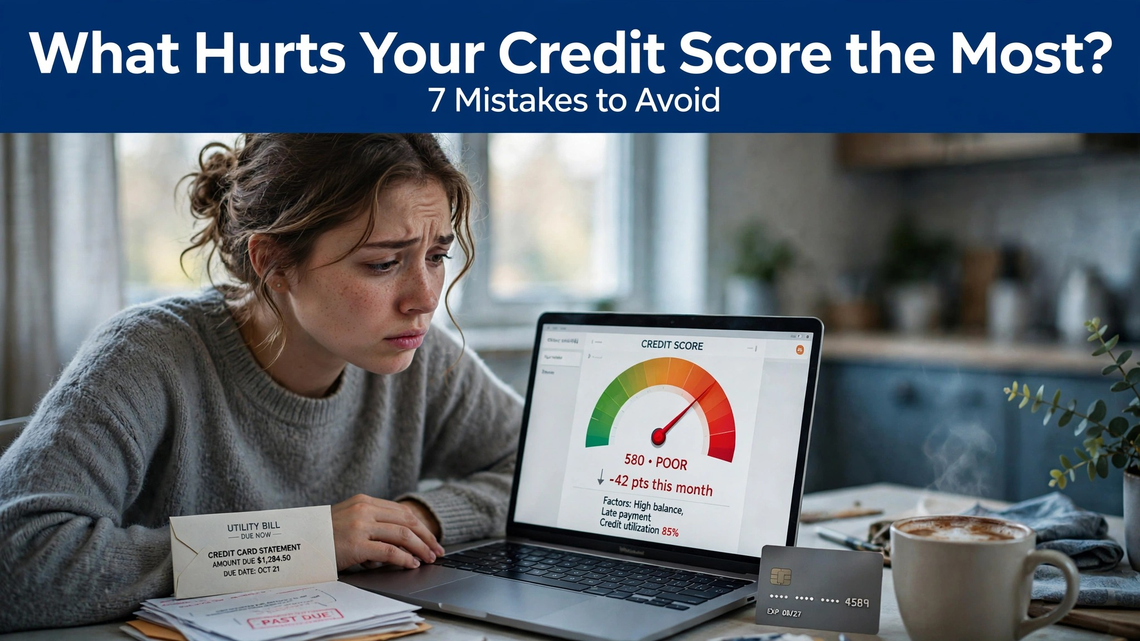
In the U.S., what hurts your credit score the most is a missed payment that reaches 30 days past due, followed by maxed-out credit cards. Collections, bankruptcy, closed old accounts, and clusters of new applications do real damage too, but late payments and high balances carry the most weight in the scoring formula.
Key Takeaways
- Payment records and what you owe drive most of your FICO score, so on-time payments and low balances beat any other habit.
- A single payment that’s 30 or more days late can hit a good score harder than it hits a weaker one.
- If you still have balances on other cards, closing an old one pushes your utilization ratio up.
- Pay your card before the statement closes, and the balance lenders see will be lower.
- Bad marks hurt a lot less as time passes, even though they’re still on your report.
What Is a Credit Score?
A credit score is a three-digit number, usually between 300 and 850, that predicts how likely you are to repay borrowed money on time, based on the records in your credit reports.
What Hurts Your Credit Score the Most?
Late or skipped payments do the most damage to your score, since payment history carries the most weight in FICO. High credit card balances sit right behind it.
Most lenders pull a FICO Score before approving a card, auto loan, or mortgage. The table below ties each mistake to the scoring category it damages, along with the quickest repair.
| Mistake | Category it damages | Category weight in a FICO Score | Fastest fix | Source |
| Paying 30+ days late | Payment history | 35% | Bring the account current and set autopay. | myFICO |
| Maxing out credit cards | Amounts owed | 30% | Pay down balances before the statement closes. | myFICO |
| Closing your oldest card | Length of credit history | 15% | Keep it open with one small monthly charge. | myFICO |
| Stacking new applications | New credit | 10% | Space applications at least six months apart | myFICO |
| Ignoring report errors | Whichever category the error touches | Depends on the error | Dispute with the bureau and the lender | Not applicable |
| Letting a debt reach collections | Payment history | 35% | Pay or settle it, and ask for a pay-for-delete in writing. | myFICO |
| Co-signing a loan that goes unpaid | Payment history | 35% | Ask to be removed, or make the payments yourself. | myFICO |
Collections and co-signed loans that go unpaid land in the payment history row, which explains why they hit so hard. Each lender sends fresh information to the bureaus about once a month, so a single wrong report can sit in that row until the next cycle corrects it.
Which Credit Mistakes Cause the Biggest Drops?
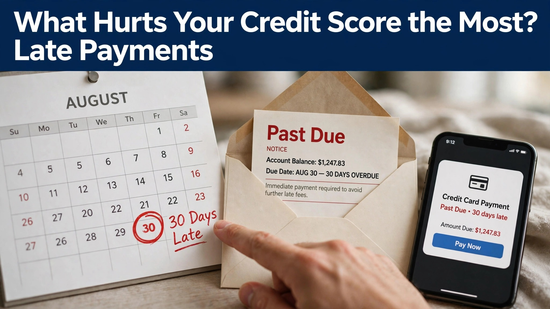
Mistakes that create a delinquency record cause the biggest drops. The damage grows with each month a payment stays unpaid, so a 90-day late mark hurts far more than a 30-day one.
- Being 30 or more days late. Lenders report it once you’re 30 days behind, and every stage after that hurts your credit score even more.
- Keeping balances close to limits. Using 90% of your limit looks risky, even if you pay on time.
- Letting a debt reach collections or charge-off. This can add two negative entries: the written-off account and the collection account.
- Closing your oldest card. Its credit limit disappears immediately, and eventually so does the lift it gives your average account age.
- Stacking new applications. Each hard inquiry trims a few points, though rate shopping for one loan in a short window counts as one.
- Co-signing for someone else. Their missed payment becomes your missed payment.
- Ignoring report errors. A wrong late mark hurts exactly like a real one until you dispute it.
Starting high makes the fall steeper. A May 2025 TransUnion analysis of student loan borrowers found that a payment 90 or more days late cost subprime borrowers about 42 points and super-prime borrowers roughly 175 points. On a 790 score, that 175-point loss leaves 615, dropping you from very good to fair.
One practical rule from money betterthisworld rule: call the lender before day 30. Many issuers will move your due date or set up a hardship plan at that stage, and neither creates a late mark.
How Does Credit Utilization Lower Your Score?

Utilization lowers your score when your reported balances eat up a large share of your total credit limits. Staying under 30% avoids most of the damage, and single-digit utilization tends to score best.
Worked example: what closing a card does
Picture two cards. Card A has a $3,000 limit and a $2,400 balance; Card B, your oldest, has a $5,000 limit and no balance.
Your total limit is $8,000, so $2,400 divided by $8,000 puts utilization at 30%. Close Card B, and the same $2,400 now sits against only $3,000, pushing utilization to 80%. Your debt never changed, yet the ratio lenders see grew by more than two and a half times.
The due-date mistake and how to fix it
Many people pay in full every month and still show high utilization. Why? Card issuers usually report the balance from your statement closing date, not your payment due date.
The fix takes one extra payment. Using the example above, send $2,000 a few days before Card A’s statement closes, and the reported balance drops to $400, which equals 5% of your $8,000 in limits. If you’re wondering how to increase your credit score quickly, this timing move is the best place to start, since most scoring models recalculate utilization from fresh data every month.
How Long Does Negative Information Stay on Your Credit Report?
Negative marks stay for years, not months. Their pull on your score weakens long before they drop off.
The Consumer Financial Protection Bureau explains that credit bureaus can generally report negative payment data for seven years and bankruptcies for up to 10.
A late payment from March 2026 can stay until about March 2033, and each on-time month after it shrinks its weight.
Here’s a point covered in the betterthisfacts tips by betterthisworldguide: paying or selling an old debt never restarts that reporting clock, so ignore any collector who claims otherwise. In some states, though, a small payment can restart the deadline for a lawsuit, so check your state’s rule first.
How Can You Repair the Damage and Raise Your Score?

Bring every past-due account current, cut your reported card balances, and dispute errors first. Those three steps produce the quickest gains, and steady on-time payments handle the rest.
According to Experian, the average FICO score in the U.S. fell to 713 in 2025, the first yearly decline since 2013. If you sit well below that, start with the table fix for your weakest category.
Pull your free reports from all three bureaus, dispute anything wrong with both the bureau and the lender, and set autopay for at least the minimum on every account.
Of all the credit score improvement tips,out there, the goodwill letter is the one people overlook most : with years of clean history and one slip, ask the lender in writing to remove the late mark. After a charge-off or bankruptcy, a secured card or credit-builder loan adds fresh on-time history every month.
When Does the Usual Advice Not Apply?
Keeping an old card open stops making sense when it charges an annual fee you can’t justify or tempts you into new debt. A $95 annual fee kept for five years costs $475, and if your other cards carry no balance, closing it barely moves your utilization. Before you cancel, ask the issuer to switch the account to a no-fee card in the same family, which usually preserves the account’s age and limit.
Frequently Asked Questions
Does checking your own credit score lower it?
No, checking your own score never lowers it. Viewing your score through a bank app, a card issuer, or a credit monitoring service counts as a soft inquiry, which lenders don’t see and scoring models ignore.
How many points does one late payment cost?
One late payment usually costs more points when your score starts high, and the exact drop depends on your full credit profile. Someone with a long, spotless record has further to fall than someone who already carries several late marks.
Does paying off a collection account raise your score?
Clearing a collection debt only boosts your score with newer scoring models. FICO Score 9, FICO Score 10, and recent VantageScore versions ignore paid collections, while older FICO versions that many mortgage lenders still use keep counting them.
Can you have a good credit score without a credit card?
Yes, you can build a good score with loans alone, but it usually takes longer. Without a card, you lose the chance to show low utilization, so many people open one no-fee card and use it for a single small bill each month.
How fast does a credit score rise after paying down cards?
A score typically rises within one or two billing cycles after lower balances reach the bureaus. Payment history damage takes much longer to fade, so balance paydowns deliver the fastest visible change.
Conclusion
What hurts your credit score the most is a payment that slips 30 days past due, with maxed-out cards close behind. Guard those two areas with autopay and pre-statement payments, and the other five mistakes become far easier to avoid. A clean, low-balance month repeated for a year beats any shortcut.





2 Comments on “What Hurts Your Credit Score the Most? 7 Mistakes to Avoid ”