

A strong letter for outstanding payment email states the exact amount, invoice number, original due date, and a firm new deadline, then explains what happens if it’s missed. Start with polite reminders, step things up on a set schedule, and keep every message calm, factual, and documented.
Key Takeaways
- Every collection email needs the invoice number, how much is owed, when it was originally due, and a new deadline.
- A seven-stage schedule running from three days before the due date to day 60 builds a paper trail that a court or collection agency can use.
- Late fees and interest hold up only when the contract or invoice terms set them before the work began.
- A final demand should name one consequence you will actually carry out, such as pausing work or filing in small claims court.
- Small claims dollar limits differ by state and sometimes by court, so check yours before you mention a lawsuit.
What Is a Strong Letter for Outstanding Payment Email?
A strong payment demand email is a written request that ties an unpaid balance to one invoice, one contractual due date, and one firm deadline so the client knows exactly what to pay, by when, and what follows silence.
Strength comes from precision, not volume. Specific figures get a better response than polite generalities because accounts payable staff can act on a dollar amount and a date without writing back to ask questions.
A strong letter is not a threat letter. It never insults, never exaggerates the balance, and never promises an action the sender has no plan to take.
What Should Every Payment Demand Email Include?
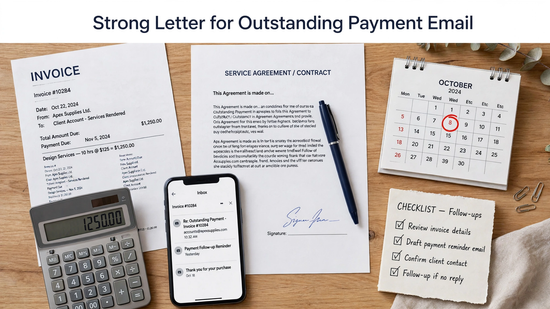
Every payment demand email needs eight elements, and leaving out any one hands the client a reason to delay. Before you hit send, run each message through this list:
- Invoice number and issue date that match your books exactly.
- The original amount and what’s still owed, with any late fees listed separately.
- Initial due date and the number of days late.
- Ways to pay: ACH details, a card payment link, or where to mail checks.
- The exact section number of the contract clause covering payment terms or late fees.
- An actual calendar date, rather than “soon” or “at your earliest convenience.”
- One consequence if they miss it.
- Attach PDFs of the invoice and signed contract
Address the person who approves payment, not only your project contact. In companies with an accounts payable inbox, copy it from the first overdue notice, because many invoices stall when the project lead never forwards them.
If your website hosts a client portal or pay-now page, place that link in the first two lines of the email. A client who can pay in one click has no logistical excuse left.
Subject lines should carry the invoice number, the status, and the amount once it changes, such as “Invoice #1047, 15 days overdue.” That format surfaces instantly in inbox search and turns the thread into clean evidence if the dispute reaches court.
When Should You Send a Payment Reminder Email?
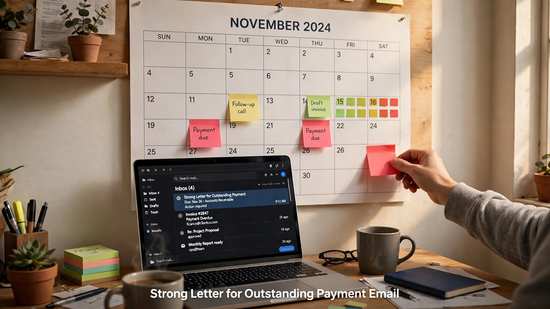
These timing tips assume net-30 terms. Issue the initial reminder three days ahead of the deadline, then intensify every one to two weeks through day 60. A predictable cadence tells the client your billing runs on process, not mood.
- 3 days before due: courtesy reminder with the invoice attached.
- Day 0: due-date notice.
- Day 7: Initial past-due notice requesting a date for payment.
- Day 15: second notice plus a phone call.
- Day 30: formal demand applying any contractual late fee.
- Day 45: final notice naming the escalation date.
- Day 60: notice of intent to file in small claims court.
Late payment is routine, not personal. Among U.S. companies surveyed for the Atradius Payment Practices Barometer 2025, overdue invoices affected 43% of B2B sales made on credit.
A studio billing $250,000 a year on credit would, at that rate, see roughly $107,500 slide past its due dates. Those dollars are what a written schedule pulls back on time.
On net-15 terms, cut each gap roughly in half; on net-60 terms, keep the same stages but make the phone call by day 10, since a long payment window already gives the client plenty of slack.
Log every touchpoint in one place: date sent, channel, recipient, and any reply. Five minutes of record-keeping per invoice saves hours if you later need to prove notice.
7 Professional Email Templates to Get Paid
Each template follows one running example so you can watch the tone harden. Maya Ortiz, a freelance designer in Austin, billed Northgate Dental $4,800 on invoice #1047 for a brand identity project, due October 1, under a contract with a 1.5% monthly late fee.
Like most of the small-business guides on money betterthisworld r, these templates are written for a one-person service business: one sender, no accounts department. Swap in your own names, figures, and dates.
1. Courtesy Reminder (3 Days Before Due)
Keep it light; the goal is catching routing problems early.
Subject: Invoice #1047 due Wednesday, October 1
Hi Dana, a quick heads-up that invoice #1047 for $4,800 is due Wednesday. ACH and card details sit on page two of the attached copy. Thanks, Maya.
2. Due-Date Notice (Day 0)
Stay neutral and assume good faith.
Subject: Invoice #1047 is due today.
Hi Dana, Invoice #1047 for $4,800 reaches its due date today. If payment already went out, thank you. If anything on the invoice needs correcting, reply today so it doesn’t stall. Maya
3. First Overdue Reminder (Day 7)
Ask a question that demands a reply: when will payment go out?
Subject: Invoice #1047, 7 days past due
Hi Dana, It looks like invoice #1047 ($4,800) was still open as of October 8. When do you expect your team to send payment? I’ve re-attached the invoice for accounts payable. Maya
4. Second Notice (Day 15)

Mention the ignored email and follow up with a call, since silence is now on record.
Subject: Second notice: invoice #1047 is 15 days overdue.
Dana, invoice #1047 for $4,800 is 15 days past due, and my October 8 email got no reply. Please send payment, or confirm a payment date, by October 20. I’ll call your office Thursday afternoon. Maya
5. Formal Demand With Late Fee (Day 30)
Give the contract clause number and spell out the new balance.
Subject: Formal notice: $4,872 now due on invoice #1047
Dana, invoice #1047 is 30 days overdue. Under Section 6 of our signed agreement, a 1.5% monthly late fee applies. That adds $72, bringing the total to $4,872. Please pay in full by November 7. Until the account is current, phase-three work is paused. Maya Ortiz
6. Final Notice Before Escalation (Day 45)
Name one dated consequence and an easy exit, like a short payment plan.
Subject: Final notice: invoice #1047
Dana, this is my last request for the $4,872 owed on invoice #1047. If I don’t have full payment or a signed two-installment plan by November 21, I’ll formally notify you that I’m filing in small claims. I’d much rather settle this between us. Maya Ortiz
If Dana accepts the plan, two installments of $4,872 mean $2,436 by November 21 and $2,436 by December 21. Put both dates in a short written agreement she signs, with an acceleration clause that makes the full balance due at once if either payment is missed.
7. Notice of Intent to File (Day 60)
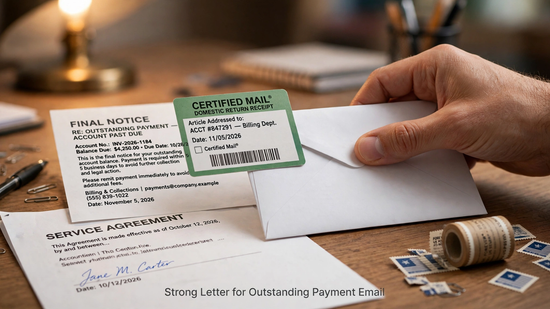
Write it like a demand letter: facts, total, deadline, venue, and attachments.
Subject: Notice of intent to file in small claims court, invoice #1047
Dana, invoice #1047 is 60 days overdue. With two months of contractual late fees, the balance is $4,944. Unless payment reaches me by December 10, I will file in Travis County Justice Court for that amount plus court costs. The contract, invoice, and every prior payment request are attached. Maya Ortiz
Across 60 days, the late fee added $144, exactly 3% of the original invoice. That sum rarely changes a client’s mind by itself. Its real job is proving, in writing, that delay carries a price that grows each month.
For template 7, send a second copy by certified mail with return receipt. The green card gives you dated proof of delivery that no client can deny receiving.
How Firm Can a Payment Demand Email Be?
A firm is legal; false or abusive is not. You can state the debt, apply agreed fees, pause work, and announce a court filing, provided every statement is true and every threat is one you’ll carry out.
The legal points below apply to the United States. Outside the US, late-fee and collection rules differ, so check local law before you threaten action.
A simple fact-check rule, the kind betterthisfacts is built on: each claim in a collection email should match a document the client already holds.
The Late-Fee Mistake and Its Fix
The most common error is adding a late fee the contract never mentioned. Sellers assume such fees are automatic, but an unauthorized charge hands the client a reason to dispute the whole balance. Put the rate in the contract and on every invoice before work starts; if you skipped that step, demand only the principal.
The “Paid in Full” Check Trap
Never deposit a short check marked “paid in full” without reading it closely. In many states, cashing that check on a genuinely disputed balance can settle the whole debt for the smaller amount under a doctrine called accord and satisfaction. If the figure falls short, return the check with a note restating the balance, or get legal advice before depositing it.
Extra Leverage for New York Freelancers
New York freelancers can point to a statute, not just a contract. The state’s Freelance Isn’t Free Act, in force statewide since August 28, 2024, requires covered clients to pay within 30 days of completed work when the contract sets no due date. If you work there, name the statute in template 5, since a client’s lawyer will recognize the double-damages exposure that comes with ignoring it.
When the Client Is a Consumer
The usual script changes when the client is an individual paying a household bill, such as a parent who owes a private tutor. Several states, California among them, extend debt-collection conduct rules to original creditors collecting consumer debts, so threats of arrest, repeated calls to a workplace, or messages to relatives are off-limits even for a sole proprietor chasing her own invoice. In that situation, keep templates 5 through 7 strictly factual and remove any language about reputation.
What Should You Do If the Client Still Won’t Pay?
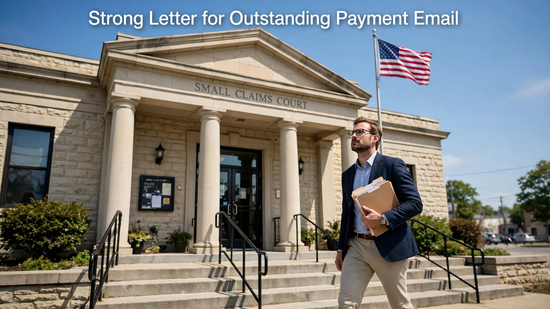
After day 60, you have three realistic options: file in small claims court, assign the debt to a collection agency, or write it off. The right choice depends on the balance, your available time, and where the client is located.
Option 1: File in Small Claims Court
For balances under your state’s small claims limit, court is usually the cheapest route because filing fees stay modest and no lawyer is required.
| Jurisdiction | Small claims limit | Who it applies to | Source |
| California | $12,500 | Individuals and sole proprietors | Superior Court of California, County of Marin |
| California | $6,250 | Corporations, LLCs, partnerships | Superior Court of California, County of Marin |
| New York City | $10,000 | Civil Court small claims part | New York State Unified Court System, CourtHelp |
| New York town and village courts | $3,000 | Justice courts outside cities | New York State Unified Court System, CourtHelp |
| Texas | $20,000 | Justice courts statewide | Texas Government Code §27.031 |
| Florida | $8,000 | County court small claims | Florida Statutes §34.01 |
Maya’s $4,944 claim fits under every limit in the table except New York’s town and village courts. If your balance tops the cap, most states let you waive the excess and sue for the maximum, which beats a full civil suit when you’re only slightly over.
What If You Win but Still Don’t Get Paid?
A court judgment is a decision, not actual cash. If the client still refuses after you win, ask the court clerk about enforcement tools such as bank levies, wage garnishment, or property liens, which vary by state.
Option 2: Hand the Debt to a Collection Agency
An agency makes sense when you lack time for court or the client has moved out of state. Most agencies work on contingency, keeping a percentage of whatever they recover, so compare that cut against the court filing fee before you sign.
Option 3: Write Off the Debt
A write-off comes last, after every other route has failed. Cash-basis businesses can’t deduct an unpaid invoice as a bad debt because that income was never reported; accrual-basis sellers generally can.
Before writing off money you earned, send template 7, since a dated court notice is often the message that finally gets a reply. Act within a year or two if you can: every state sets a deadline for suing on a contract, and evidence fades long before it expires.
Frequently Asked Questions
How do you politely ask for an outstanding payment?
Lead with the invoice number, amount, and due date, then ask when payment will go out. Courtesy lives in tone, not vagueness, and a direct question earns a faster answer than a hopeful hint.
Can I charge interest on an overdue invoice?
Yes, if your contract or invoice terms set the rate before the work began. Without that agreement, the charge invites a dispute, and state usury laws cap how high any rate can go.
Does an email count as a formal demand letter?
An email can serve as a demand letter if it clearly states the debt, the deadline, and the consequence. For the final notice, many sellers also mail a certified copy to prove delivery.
How long should I wait before sending a final notice?
Send the final notice about 45 days after the due date, once earlier reminders and a phone call go unanswered. On net-15 terms, move it closer to day 30.
Should I stop work for a client who hasn’t paid?
Pausing work is reasonable once an invoice is 30 days late, as long as your contract allows it. Announce the pause in writing with a start date, and resume only when the account is current.
Conclusion
A strong letter for outstanding payment email works because it strips out guesswork: one invoice, one amount, one deadline, and one consequence. Send the seven messages on schedule, keep each one factual, and the record you build will either get you paid or win your case.