

To learn how to buy a house through an LLC, start by forming the company in the state where the property sits, signing an operating agreement, and opening a business bank account. Then make the offer, arrange financing, and close in the LLC’s name, never your own.
Key Takeaways
- An LLC protects you only when it buys, titles, insures, and pays for the house in its own name.
- Most conventional mortgages go to individuals, so LLC buyers usually rely on cash, DSCR loans, or local portfolio lenders.
- Forming the LLC in a different state from the property adds a second set of state fees without adding protection.
- A single-member LLC is taxed like its owner by default, so rental income and deductions land on the owner’s personal return.
- Mixing personal and company money gives creditors an argument for piercing the LLC’s shield.
What Is an LLC Home Purchase?
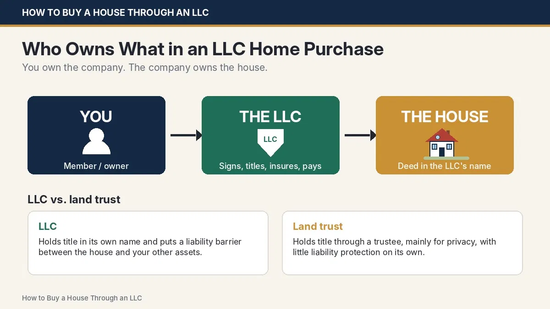
An LLC home purchase is a deal in which a limited liability company, not an individual, takes title to a house and appears as the owner on the recorded deed.
You own the company. The company owns the house, signs the contracts, and carries the liabilities tied to it.
Some states also allow a series LLC, which walls off several properties inside one entity. Rules differ sharply from state to state. Our sister site betterthisworld covers the basics, but confirm with your Secretary of State before you rely on one.
- LLC: holds title in its own name and puts a liability barrier between the house and your other assets.
- Land trust: holds title through a trustee, mainly for privacy, with little liability protection on its own.
How to Buy a House Through an LLC, Step by Step
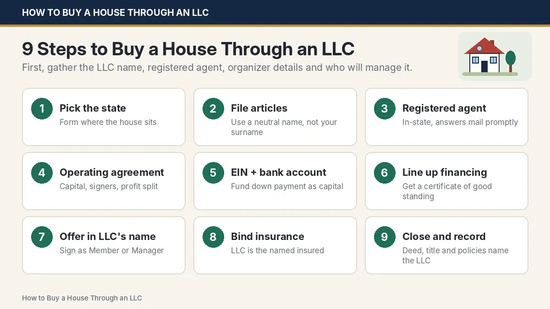
Build the company before you shop, because purchase contracts, loan files, and title commitments all need a finished entity with its own tax ID. Nine steps cover the sequence.
Gather the info every state form asks for before you file: the LLC name, a registered agent and in-state address, the organizer’s details, and whether members or a manager will run the company.
- Choose the formation state. Form the LLC where the house sits; an out-of-state company must register there anyway.
- File articles of organization. Use a neutral name, such as the street name plus “Holdings,” rather than your surname.
- Appoint a registered agent. The agent accepts lawsuits and state notices at an in-state address, so pick someone who answers mail promptly.
- Sign an operating agreement. Spell out capital contributions, who signs closing papers, how profits split, and who takes control if a member dies or becomes incapacitated.
- Get an EIN and open a business account. Contribute the down payment and reserve money as capital, and keep a paper trail showing it.
- Line up financing or proof of funds. Order a certificate of good standing from the state, since lenders and title companies both want a recent one.
- Make the offer in the company’s name. Sign as “Member” or “Manager” of the LLC, never as yourself.
- Bind insurance before closing. A landlord policy and an umbrella policy should list the LLC as the named insured, not you.
- Close and record. Confirm that the deed, the owner’s title policy, and every insurance declaration page name the LLC.
One form drops off older checklists. An interim final rule published in the Federal Register in March 2025 exempted companies created in the United States from beneficial ownership reporting to the Treasury, so spend that hour tightening step 4 instead.
Which Type of LLC Should Own the House?
A solo buyer usually picks a single-member, member-managed LLC. Co-investors, including couples who split the down payment, need a multi-member LLC with a detailed operating agreement.
Single-Member or Multi-Member
A single-member LLC keeps paperwork light because its income lands on your personal return. Its weakness is creditor protection: in some states, a court can let your personal creditor reach the company’s assets when you are the only member.
A multi-member LLC files its own partnership return. In many states it gets stronger charging-order protection, which limits a member’s creditor to that member’s share of distributions.
Member-Managed or Manager-Managed
Members run a member-managed LLC directly. A manager-managed LLC hands authority to a named manager, which suits passive partners and can keep some members’ names off state filings.
One LLC Per Property, or One for Everything?
Use a separate LLC for each house once you hold more than one rental with real equity. A tenant’s lawsuit over one property then reaches only that property, though each extra LLC adds another annual state charge.
Some states also allow a series LLC, which walls off several properties inside one entity.Series LLC rules differ sharply from state to state. Treat any general overview, whether on betterthisfacts or a legal blog, as a starting point, and confirm with your Secretary of State before you rely on one.
How Much Does It Cost to Own a House in an LLC?
Budget for a one-time filing fee plus a yearly state charge that lasts as long as the company exists. Where you form the LLC, relative to the house, drives the total.
| Setup | Formation cost | Recurring state charge | Source |
| California LLC owning a California house | $70 Articles of Organization | $800 minimum annual tax | California Secretary of State; California Franchise Tax Board |
| Wyoming LLC with no out-of-state property | $100 Articles of Organization | $60 minimum annual report license tax | Wyoming Secretary of State |
| Wyoming LLC owning a California house | $100 formation plus $70 foreign registration (Form LLC-5) | $60 Wyoming plus $800 California | Wyoming Secretary of State; California Secretary of State; California Franchise Tax Board |
Costs Beyond State Fees
State fees are only part of the bill. Also budget for:
- A registered agent service, unless you serve as your own
- An attorney’s review of the operating agreement
- A CPA if the LLC files a partnership return
- Landlord insurance, which typically costs more than a standard homeowner’s policy
The Out-of-State LLC Mistake
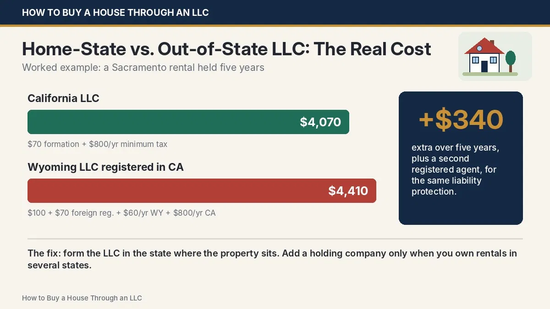
Forming in a low-fee state to hold a house elsewhere usually costs more, not less, because the property’s state still requires foreign registration and its own annual charge.
Across our money betterthisworld we see the same mistake: budget advice that quotes only a state’s filing fee. The recurring charges and the foreign registration decide the real total.
Worked Example: A Sacramento Rental Held Five Years
- California LLC: $4,070 in state charges
- Wyoming LLC registered in California: $4,410, assuming four Wyoming annual reports after the formation year
- Difference: $340 extra, plus a second registered agent, for the same liability protection
The fix: form in the property’s state, and add a holding company only when you own rentals in several states and an attorney has priced each filing.
Can You Get a Mortgage on a House Bought Through an LLC?
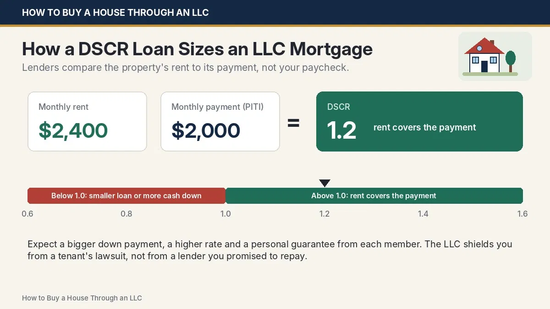
Yes, though rarely a conventional owner-occupant loan. Most LLC buyers close with cash, a DSCR loan, or a local bank’s portfolio loan.
How a DSCR Loan Works
A DSCR (debt service coverage ratio) lender sizes the loan on the property’s rent versus its payment, not your paycheck.
- Monthly rent: $2,400
- Monthly payment (principal, interest, taxes, insurance): $2,000
- DSCR: 1.2, so the rent covers the payment with room to spare
Below 1.0, the rent no longer covers the payment and the lender shrinks the loan or asks for more cash down.
Expect a bigger down payment, a higher rate, and a personal guarantee from each member. That guarantee matters, because the LLC shields you from a tenant’s lawsuit, not from a lender you promised to repay.
What Lenders and Title Companies Ask For
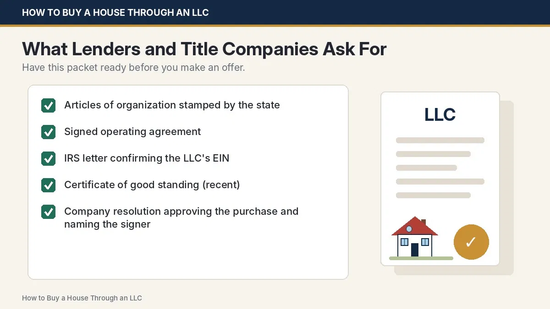
Have this packet ready before you make an offer:
- Articles of organization stamped by the state
- The signed operating agreement
- The IRS letter confirming the LLC’s EIN
- A certificate of good standing dated within the last few weeks
- A company resolution approving the purchase and naming who signs
Moving a House You Already Own Into an LLC
Moving a mortgaged property into an LLC can give the lender grounds, under the due-on-sale clause, to demand the whole loan be paid off. Get the servicer’s written consent first, and ask your title insurer for an endorsement so coverage follows the transfer.
Paying All Cash
All-cash LLC purchases briefly carried a federal closing report in 2026. FinCEN’s Residential Real Estate FAQ page says a federal court in Texas vacated that rule on March 19, 2026, the government has appealed, and closing agents need not file while the order stands.
Keep member IDs and your operating agreement in the closing folder anyway, and follow news on the appeal, because a reversal would restore the report for cash deals.
How Is a House Owned by an LLC Taxed?
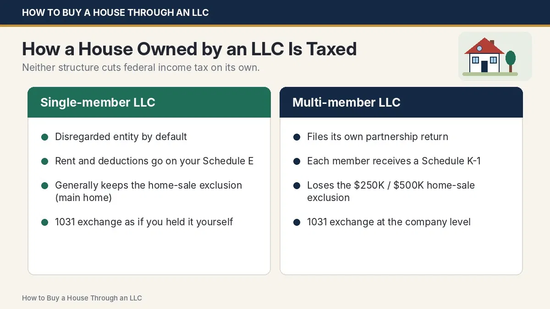
A single-member LLC is a disregarded entity by default, so rent, interest, depreciation, and repairs go on Schedule E of your own return. An LLC with more than one member files a partnership tax return and issues each member a Schedule K-1.
Neither structure cuts federal income tax; rental deductions exist with or without an LLC.
Record-Keeping Tips for an LLC Rental
Three tips keep the LLC’s tax records clean:
- Save the closing statement. It sets your cost basis.
- Split land from building. Only the building depreciates.
- Route all money through the LLC account. Your Schedule E then matches the bank statements.
State Taxes and 1031 Exchanges
Check state rules separately, since some states charge transfer tax on a deed into an entity.
Plan exits early too. A disregarded LLC can generally complete a 1031 exchange as if you held the house yourself, while a multi-member LLC must exchange at the company level unless the members restructure well before the sale.
The Exception: A House You Will Live In
The usual advice flips for a primary residence:
- Low-down-payment owner-occupant loans go to people, not companies.
- Many counties deny homestead exemptions to entity-owned homes.
- An LLC adds little liability value when no tenant lives there.
The tax stakes are larger still. IRS Publication 523 lets a seller exclude up to $250,000 of gain, or $500,000 on a joint return, after owning and living in a main home two of the prior five years.
A disregarded single-member LLC generally keeps that break. A multi-member LLC taxed as a partnership loses it, so a $300,000 gain shifts from tax-free to fully taxable.
What Mistakes Break an LLC’s Liability Protection?
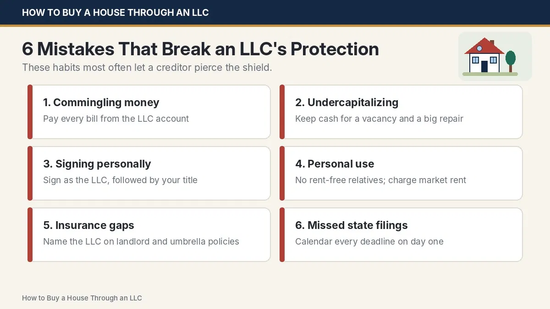
Commingling money, signing personally, and missing state filings are the habits that most often let a creditor pierce the shield.
1. Commingling Money
Say you repaint the rental before listing it, using a neutral like BM Edgecomb Gray that appeals to most tenants. Pay the painter from the LLC account, not your personal card, and file the invoice in the company’s books.
2. Undercapitalizing the LLC
Keep enough cash in the business account to cover a vacancy and a major repair, so you never fund the house from personal checking.
3. Signing in Your Own Name
Sign every lease, vendor contract, and repair agreement as the LLC, followed by your title.
4. Personal Use of the Property
Letting a relative live in the house rent-free tells a court the LLC is your personal piggy bank. Charge market rent and record it like any other tenant’s payment.
5. Insurance Gaps
A policy left in your own name often won’t respond to a claim against the LLC, so move landlord and umbrella coverage into the company’s name at closing.
6. Missed State Filings
Missed annual reports can lead to administrative dissolution, leaving the house titled to a company that is no longer in good standing. Put every state deadline on a calendar the day the LLC is approved.
Frequently Asked Questions
Is it better to buy a house in an LLC or in your own name?
For a rental, an LLC usually makes sense; for a home you live in, personal ownership usually wins. The deciding factors are tenant lawsuit risk and whether you need owner-occupant financing.
Can I live in a house my LLC owns?
You can, but you give up most of the benefits and take on new costs. Expect pricier financing and a likely loss of the homestead exemption.
Does an LLC keep my name off public records?
Only partly, because lenders, title companies, and courts can still identify the members. Some states let a registered agent appear on formation papers instead of you.
Do I need a lawyer to buy property through an LLC?
No state requires one for a simple purchase, but some deals justify the fee. Hire one for a multi-member LLC or a transfer of a mortgaged house.
How long does it take to set up an LLC to buy a house?
State filing often finishes within days, but the full setup takes longer. Investor loan approval sets the real timeline, so form the company before touring homes.
Conclusion
Knowing how to buy a house through an LLC comes down to sequence: form the company in the property’s state, fund it, and close in its name. The protection lasts only as long as the discipline does, with separate money, LLC-named insurance, and on-time state filings every year.