

The clearest signs you are living beyond your means are carrying a credit card balance month to month, having no cash cushion, and needing next month’s paycheck to cover this month’s bills. The fix is a written spending audit, a small emergency fund, and a debt payoff plan you automate.
Key Takeaways
- Carrying a credit card balance from one month to the next is the most reliable early sign of overspending.
- Your spending is too high if a surprise bill of a few hundred dollars forces you to borrow.
- Paying $150 a month on a $6,000 card balance at a typical 2026 card rate costs more than $5,100 in interest.
- A 48-hour waiting rule on non-essential purchases cuts impulse spending without a rigid budget.
What Is Living Beyond Your Means?
Living beyond your means is spending more each month than your take-home pay covers, then filling the gap with credit, loans, or shrinking savings.
What Are the Signs You Are Living Beyond Your Means?
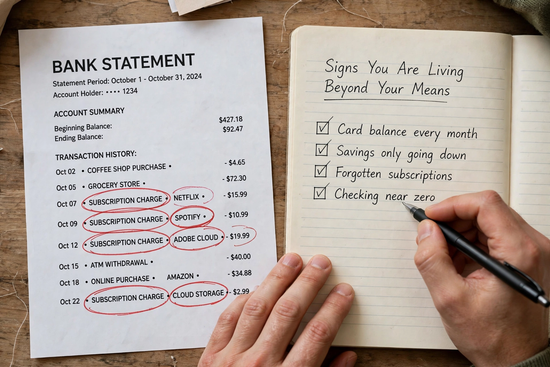
Your statements show the warning signs before your stress level does. If three or more of these describe your last 90 days, spending has outrun income.
Below is the 12-point checklist from our money betterthisworld guides. Each sign comes with one fix you can start this week.
- You carry a card balance every month. Fix: freeze new charges until it hits zero.
- Your savings balance only moves down. Fix: transfer in $10 every payday.
- You can’t name your monthly spending within $100. Fix: run a 30-day audit of every account.
- Checking nears zero before each deposit. Fix: hold back one week of spending as a floor.
- The minimum payment feels like the real payment. Fix: set autopay to a fixed amount above it.
- You split groceries or gas into buy now, pay later installments. Fix: pay open plans off and move everyday purchases back to debit.
- Subscriptions renew unnoticed. Five forgotten $12 services drain $720 a year. Fix: cancel anything unused in 30 days.
- You paused retirement contributions “for now.” Fix: restore enough to earn the full employer match.
- Rent or a car payment eats more than a third of take-home pay. Fix: plan the downgrade at renewal.
- You hide purchases from a partner. Fix: agree on a no-questions allowance.
- Your last raise vanished into a bigger lease and more takeout. Fix: send half of every future raise to savings.
- One $500 car repair would land on a credit card. Fix: build a $1,000 starter cushion first.
How Much Does Living on Credit Actually Cost?
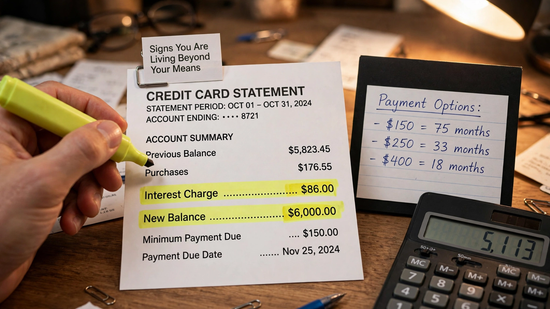
It costs far more than the price tags suggest, because interest compounds on every unpaid dollar.
Credit card accounts that paid interest averaged a 22.36% rate in the third quarter of 2026, according to the Federal Reserve’s G.19 Consumer Credit release. Run a $6,000 balance through that rate, and your payment decides everything:
- $150 a month: 75 months to clear, about $5,113 in interest.
- $250 a month: 33 months, about $2,027.
- $400 a month: 18 months, about $1,103.
Jumping from $150 to $400 saves roughly $4,000 and nearly five years. One betterthisfacts takeaway worth remembering: the size of your payment matters more than your interest rate. That extra $250 a month is often hiding in sign 7 (forgotten subscriptions) and sign 11 (a raise that went to lifestyle).
The Balance-Transfer Mistake
A 0% promotional card works only if the old card stays empty. People slip because the cleared credit line feels like new spending room.
The fix: lock the old card the day the transfer posts, then divide the balance by the promo months. $6,000 over 15 months means $400 on autopay.
How Do You Fix Living Beyond Your Means?

Measure first, cut second, and automate third.
Run a 30-Day Spending Audit
Export 30 days of transactions and tag each line as need, want, or debt. A household bringing home $5,200 a month that finds $640 in delivery orders and app charges has located over 12% of its income in one afternoon.
Cut One Big Fixed Cost
One fixed-cost cut beats a dozen skipped lattes because it repeats every month without effort. Shop your car insurance at renewal, drop to a prepaid phone plan, or refinance a high-rate auto loan; trimming $120 a month frees $1,440 a year.
Use the 48-Hour Rule
The easiest way to stop impulse buying and save money is to add friction. Wait 48 hours before any non-essential purchase over $50, and delete stored card numbers from shopping apps.
Build a Starter Cash Cushion
Target $1,000 first, then one month of expenses, then three to six months. Just 63% of adults reported they could cover an unexpected $400 expense with cash or equivalent, based on the Federal Reserve Board’s Economic Well-Being of U.S. Households in 2025 report.
That leaves 37% one flat tire away from new debt. A $20 weekly transfer reaches $400 in 20 weeks and $1,000 in 50.
Which Debt Should You Pay Off First?
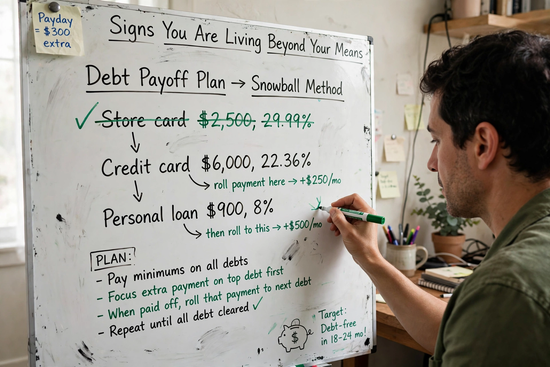
Pay the highest-interest debt first to save the most money, or the smallest balance first if quick wins keep you motivated. Either order beats spreading extra cash evenly across every account.
Here is a worked example with $600 a month aimed at three debts:
| Debt | Balance | Rate | Minimum |
| Personal loan | $900 | 8% | $50 |
| Store card | $2,500 | 29.99% | $75 |
| Credit card | $6,000 | 22.36% | $150 |
- Pay every minimum on time, every month.
- Send the leftover $325 to one target debt only.
- When that debt hits zero, roll its full payment into the next target.
The avalanche order (store card, credit card, loan) finishes in 19 months with about $1,768 in interest. The snowball order (loan, store card, credit card) also takes 19 months but costs about $1,919, roughly $151 more. Our betterthisworld tip for choosing: if you have quit a payoff plan before, choose the snowball. Its first paid-off debt arrives in month 3, while the avalanche makes you wait until month 7.
Already Behind on a Payment?
Pay at least the minimum before the bill reaches 30 days past due, because that is the point when card issuers typically report a late payment to the credit bureaus. If you can’t, call the issuer and ask for a hardship plan with a lower rate or reduced payment before the account slips further.
How Do You Overcome Financial Anxiety While Paying Down Debt?
Anxiety eases fastest when vague worry becomes a fixed weekly routine with one visible measure of progress. to overcome financial anxiety , shrink the unknowns.
Fewer than half of U.S. adults, 47%, said they could reach enough cash or credit to handle a $1,000 surprise, according to Bankrate’s 2026 Annual Emergency Savings Report. That test uses $1,000 rather than $400, so it measures a deeper level of readiness. If you fall in the other 53%, you’re in the majority.
Three habits keep the routine light:
- Hold a 15-minute money check-in every Sunday: balances, bills due, and one win.
- Track one number, total non-mortgage debt, and chart it monthly.
- If stress stays high despite progress, book a session with a nonprofit credit counseling agency.
What Smart Money Habits Build Wealth After You Stop Overspending?

Wealth grows from paying yourself first, saving part of every raise, and investing in low-cost retirement accounts. These are smart money habits to build wealth because they are boring and automatic.
Schedule transfers for payday, capture your full 401(k) match, and raise your savings rate by one percentage point every six months. Money you never see in checking rarely gets spent.
Here is where U.S. households stand right now and what each number means for your own plan.
| Measure | Latest figure | Period | What it means for you | Source |
| U.S. credit card balances | $1.263 trillion | Q2 2026 | Expect constant credit offers; decline by default. | Federal Reserve Bank of New York |
| Card balances moving into 90+ day delinquency (annualized) | 6.97% | Q2 2026 | Tracks dollars, not people; one missed payment starts the slide. | Federal Reserve Bank of New York |
| Personal saving rate | 3.8% | September 2026 | Economy-wide average, not a personal target; aim higher | U.S. Bureau of Economic Analysis |
| Adults with more card debt than emergency savings | 29% | December 2025 survey | Split extra cash between debt and savings. | Bankrate |
| Adults with no emergency savings | 24% | December 2025 survey | One $20 transfer moves you out of this group. | Bankrate |
| Adults whose emergency savings did not grow in a year | 58% | December 2025 survey | Flat savings plus rising prices means less buying power. | Bankrate |
The saving rate covers the whole economy; the survey rows describe individual adults. Compare yourself with the survey rows, not the national average.
When Does Spending More Than You Earn Make Sense?
A short, planned deficit is reasonable when it has an end date and a defined payoff source.
Most budgeting tips assume a steady paycheck, so they bend for commission earners and freelancers, who should budget from their lowest month of the past year. A job gap covered by an emergency fund, a medical crisis, or a certificate tied to a specific higher-paying role all qualify, since drawing down savings there is the plan working. If you can’t name the end date and the money that refills the gap, it’s overspending with a better story.
Frequently Asked Questions
How do I know if I am living beyond my means?
You are living beyond your means when monthly spending plus debt payments exceeds your take-home pay. Compare 30 days of transactions with your deposits.
What share of income should go to fixed expenses?
Keep essential fixed costs at or below half of take-home pay. On $5,200 a month, that caps housing, utilities, insurance, transportation, and minimum debt payments at $2,600.
Is it bad to use credit cards if I pay them off monthly?
No, paying the full statement balance every month avoids interest and builds credit history. Trouble starts the first month you carry a balance, because most issuers then charge interest on new purchases too.
How long does it take to stop living paycheck to paycheck?
Plan on three to six months if you redirect 5% to 10% of take-home pay to savings. On $5,200 take-home, saving 7%, or $364 a month, builds a $2,184 cushion in six months.
Can a budget app fix overspending?
A budget app helps only if you review it weekly and act on what it shows. Automatic payday transfers, not the app, actually move the money.
Conclusion
Signs you are living beyond your means show up in your statements first, and one honest look is enough to spot them. Fixing them takes a plan that runs without motivation. Cut one category, send that cash to debt and savings on payday, and let compounding work for you instead of against you.

One comment on “12 Signs You Are Living Beyond Your Means (And How to Fix Them) ”