
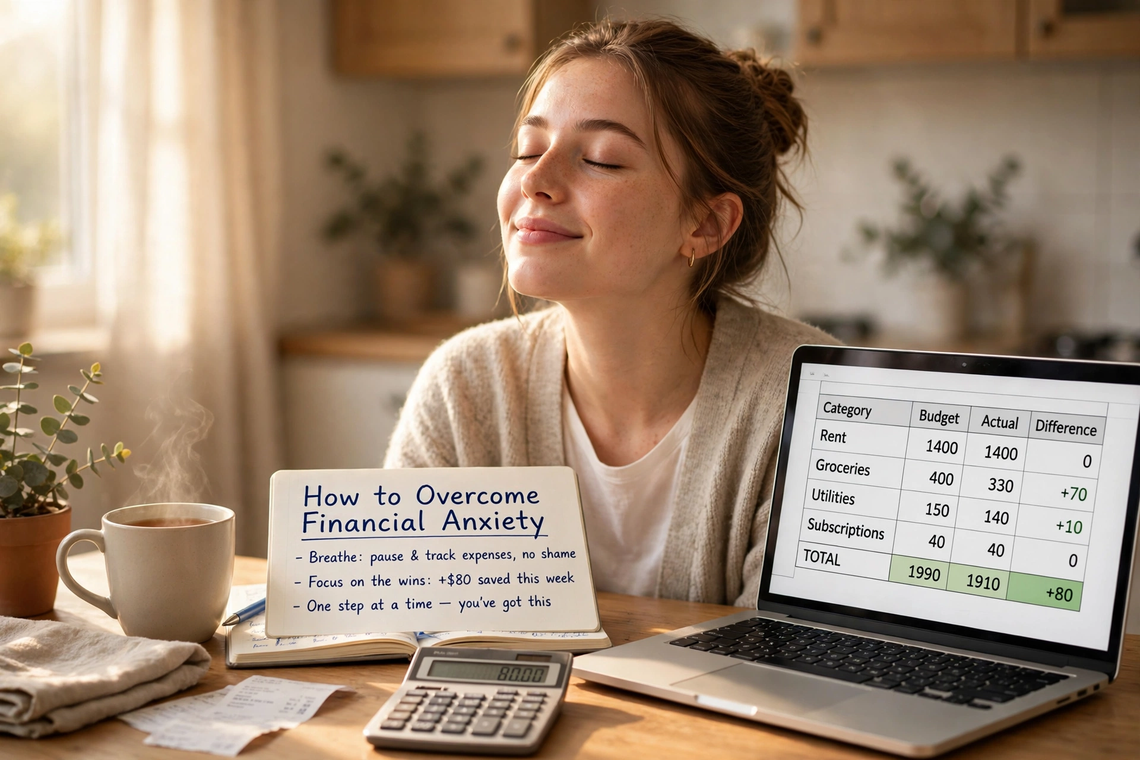
To learn how to overcome financial anxiety, Swap vague dread for real numbers: write down every bill, save a little cushion, and tackle high-interest debt on a set schedule. Add some spending limits and a quick 20-minute check of your accounts each week, and the fear starts to fade.
Key Takeaways
- Financial anxiety eases once the unknowns turn into a simple written list: balances, due dates, and interest rates.
- Start with $400 for small surprises, then work toward three to six months of essential expenses as your safety net.
- Paying $300 a month instead of $150 on a $6,000 card balance at about 22% APR cuts payoff time from 75 months to 26 and saves roughly $3,500 in interest.
- Payment history and amounts owed together make up 65% of a FICO Score, so on-time payments and low balances matter most.
- Free credit reports from Equifax, Experian, and TransUnion are available every week at AnnualCreditReport.com.
What Is Financial Anxiety?
Financial anxiety is persistent worry, tension, or avoidance tied to money that shows up as dodging bank statements, losing sleep over bills, or freezing when a decision is due.
Unlike ordinary budget stress, it lingers after the bills are paid.
What are the signs and common triggers?

The signs fall into three groups: physical, behavioral, and mental. Spotting your pattern tells you which step below to start with.
- Physical: headaches, a tight chest, poor sleep, or appetite changes that cluster around payday and due dates.
- Behavioral: unopened mail, a deleted banking app, overspending for quick relief, or refusing to pay for genuine necessities.
- Mental: replaying worst-case scenarios, comparing yourself with friends, and losing focus at work.
Typical triggers include a job loss or pay cut, a surprise medical or car bill, a rent increase, a partner with different spending habits, and debt that grows faster than payments shrink it. You’ll find more information by betterthisworld on money and well-being. Treat this list as education; physical symptoms that last for weeks deserve a visit to a doctor or licensed therapist.
How to Overcome Financial Anxiety: Where Do You Start?
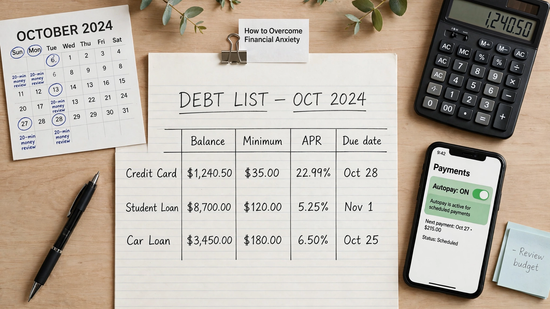
Start by measuring the problem. Dread feeds on blanks, and four steps fill them in over a single weekend.
- Write down your real number. Record each debt, noting its balance, minimum payment, interest rate, and deadline. Seeing “$11,400 across four accounts” feels heavy for ten minutes and lighter for months.
- Book a weekly review. Spend 20 minutes at a fixed time checking balances and paying what is due. When a worry pops up midweek, jot it on a note and save it for that slot instead of letting it run all day.
- Automate every minimum payment. Autopay removes the late fees and credit damage one forgotten due date brings, and it frees your attention for the account you are attacking.
- Build a $400 starter buffer. Move $25 to $50 per paycheck into a separate high-yield savings account until it holds $400, then $1,000.
Our money betterthisworld guides put this step first for a reason: nobody can shrink a figure they have never written down.
The Federal Reserve Board’s Economic Well-Being of U.S. Households in 2025 report, released in May 2026, found that 63% of adults would cover a $400 emergency with cash or its equivalent.
Flip that figure: roughly 37 of every 100 adults would borrow, sell something, or fall short, so reaching $400 puts you ahead of over a third of the country.
What Is the Fastest Way to Pay Off Debt?
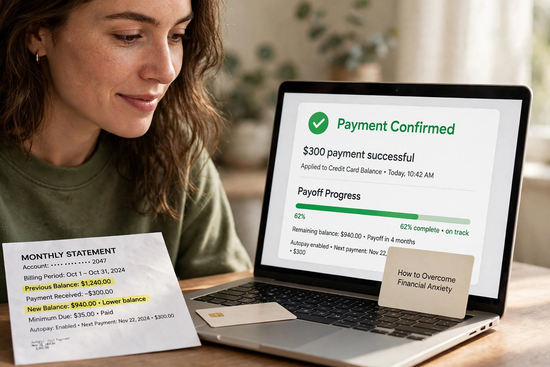
Raise the payment on one target account and leave the rest on autopay minimums. Payment size matters more than method.
- Pick a payoff method. When comparing the debt snowball vs debt avalanche method, the avalanche targets the highest APR first and saves the most interest. Snowball clears the smallest balance first, giving anxious borrowers visible proof of progress.
- Double the payment on your target card, even if that means trimming other spending for a few months.
- Cut the rate. Call your issuer and ask for a lower APR, then ask about hardship programs if the answer is no. With good credit, a 0% balance transfer card or a fixed-rate consolidation loan also lowers the cost; compare the transfer fee and the date the promotion ends before moving a balance.
In the Federal Reserve’s G.19 Consumer Credit release from November 2026, the average rate on bank card accounts assessed interest stood at 22.36% for the third quarter.
At that rate, a $6,000 balance adds about $112 in interest in month one. Pay $150 a month, and the card takes 75 months to clear, costing about $5,113 in interest. Raise the payment to $300, and it disappears in 26 months for roughly $1,577.
That extra $150 buys back four years and keeps about $3,536 with you. If you want to know how to get out of debt fast , pull this lever first.
What mistake slows debt payoff the most?
Spreading spare cash thinly across every card is the most common error. It feels fair, yet no balance drops fast enough to show progress. Fix it by sending every extra dollar to one account until it reads zero, then rolling that payment into the next.
How Do You Build Credit Without Carrying a Balance?
Treat a credit card like a debit card with a one-month delay: charge only what sits in checking, and pay the full statement balance.
Americans owed a record $1.29 trillion on credit cards in the third quarter of 2026, according to the Federal Reserve Bank of New York’s Quarterly Report on Household Debt and Credit. A card paid in full monthly charges zero interest and still reports positive history.
- Keep utilization low. Use under 30% of each limit, ideally under 10%; on a $2,000 limit, that means a balance below $200.
- Pay before the statement closes. Issuers report the closing balance, so paying mid-cycle lowers what the bureaus see.
Those habits, plus autopay, are the core of how to use a credit card responsibly to build credit. Keep your oldest no-fee card open and use it for one small recurring bill, such as a streaming plan, so the account stays active and keeps lengthening your history.
Which Credit Mistakes Cost the Most Points?
Missed payments and maxed-out cards do the most damage, because they hit the two heaviest factors in the formula. Issuers generally report a payment as late once it is 30 days past due, and most negative marks stay on your report for seven years.
So what hurts your credit score the most? The first two rows of this table, by a wide margin.
| FICO factor | Share of score | What damages it | Practical fix | Source |
| Payment history | 35% | Payments 30+ days late, collections | Autopay at least the minimum. | myFICO: What’s in my FICO Scores? |
| Amounts owed | 30% | High balances relative to limits | Pay down before the statement closes. | myFICO: What’s in my FICO Scores? |
| Length of credit history | 15% | Closing your oldest account | Keep old no-fee cards open. | myFICO: What’s in my FICO Scores? |
| New credit | 10% | Several applications in a short window | Space out new applications. | myFICO: What’s in my FICO Scores? |
| Credit mix | 10% | Rarely the main problem | Never borrow just to add variety. | myFICO: What’s in my FICO Scores? |
Reporting errors drag scores down too. The Federal Trade Commission confirmed in October 2023 that the three national bureaus now permanently offer a free report from each of them once a week at AnnualCreditReport.com. Pull all three before any loan application, and dispute an account you do not recognize directly with the bureau that lists it.
How Can You Spend Less on Impulse and Save More?
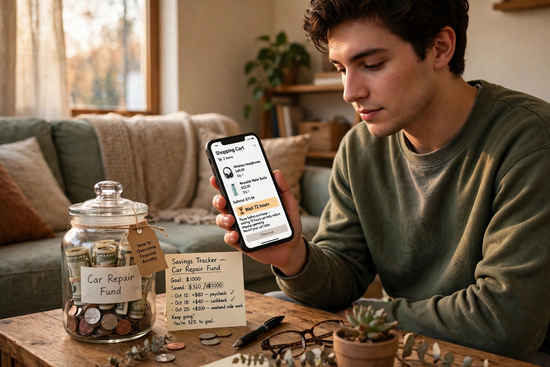
Put friction between the urge and the checkout button. A delay, a cap, and an automatic transfer outperform willpower.
- Use a 72-hour rule. Any nonessential item over $50 waits three days. Delete saved card numbers from shopping apps, turn off one-click ordering, and unsubscribe from retailer emails.
- Pay yourself first. Schedule a payday transfer into savings named for a goal, such as “Car repair fund,” so the cash leaves checking before you can spend it.
Track the pattern behind the urge. Note the time, place, and mood behind your last five unplanned purchases; late-night scrolling or a post-payday splurge points to the exact spot that needs friction. Watch buy-now-pay-later plans as well, since four small installments across several stores add up to one large monthly bill.
When people look up how to stop impulse buying and save money, they often expect a strict budget to do the work, yet small swaps compound faster. Skip two $40 impulse orders a month, auto-save that $80, and you add $960 in a year, more than doubling a $400 starter buffer.
How Do You Keep Your Finances on Track Once the Panic Fades?

Switch from emergency mode to a light, repeatable system built on a simple spending split and a monthly check of your progress.
- Keep a one-line monthly log. Each month, record total debt, savings, and your anxiety level from 1 to 10. Watching both numbers fall breaks the link between your balance and your mood.
The 50/30/20 split makes a workable starting frame. On $4,000 of monthly take-home pay, that means $2,000 for needs, $1,200 for wants, and $800 for savings and extra debt payments. Adjust the ratios if rent alone eats half your income.
Once the starter buffer is full and high-interest cards are gone, grow the emergency fund to three to six months of essentials. If needs cost $2,500 a month, the target runs from $7,500 to $15,000. Couples should add a 15-minute monthly meeting to review the log together, which removes the surprise that fuels many arguments.
Knowing how to manage money effectively means checking a few numbers on the schedule, not tracking every latte.
When does this advice not apply?
These steps assume a steady paycheck. Gig workers and commission earners whose income swings more than 25% month to month should budget around their lowest-earning month of the past year, sending anything above it to the buffer first, then to debt. When an account sits in collections or a lawsuit is pending, have a nonprofit credit counselor or consumer attorney review the file before you send extra payments anywhere.
Frequently Asked Questions
Is financial anxiety a mental health condition?
Financial anxiety is not a formal diagnosis, but it overlaps with general anxiety and affects sleep, focus, and relationships. When worry runs your days for weeks, a licensed therapist and practical steps help.
Can financial anxiety cause physical symptoms?
Yes, constant financial worry often shows up as headaches, restless nights, tight shoulders, or stomach trouble. Symptoms that persist deserve a doctor’s visit, since stress-related problems tend to ease once the cause gets addressed.
How long does it take to feel less anxious about finances?
The first shift usually comes the day you finish your debt list, because the unknown total drives much of the dread. Deeper relief builds as balances drop and the buffer grows.
Should I save or pay off debt first?
Build a starter buffer of $400 to $1,000 first, then send extra cash to high-interest debt. Without one, a car repair lands right back on the card.
Does checking my own credit score lower it?
No, viewing your own credit score counts as a soft pull and won’t lower it. Only hard inquiries from credit applications count against you.
Where can I get free help with debt and financial stress?
A nonprofit credit counseling agency offers free or low-cost budget reviews and debt management plans. Choose one accredited by the National Foundation for Credit Counseling.
Conclusion
Learning how to overcome financial anxiety comes down to trading fear for figures: a written debt list, a $400 buffer, and one payment raised on purpose. Do those three things this month, and every later step gets easier. Financial control is a habit you build weekly, not a feeling you wait for.