
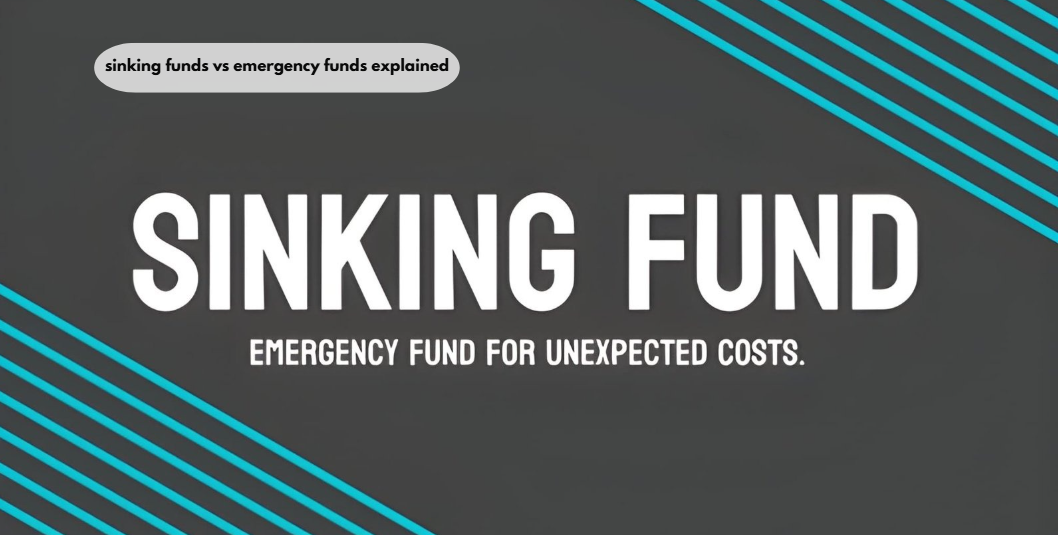
A sinking fund is money you save on purpose for a specific expense you already know is coming, like a car repair or a holiday trip, while an emergency fund is cash set aside for unexpected costs you can’t predict, like a job loss or medical bill. Understanding sinking funds vs emergency funds explained side by side is the first step toward actually using both correctly.
What Is the Difference Between a Sinking Fund and an Emergency Fund?

Most people mix these two up because both sit in a savings account and feel like extra cash. But the intent behind each is completely different, and that distinction matters more than you think.
A sinking fund is cash you set aside gradually for a known, predictable expense—like holiday gifts, annual insurance, or new tires coming up in eight months. None of these are surprises; you see them coming and chip away at them monthly instead of scrambling for a lump sum later.
An emergency fund is reserved strictly for unplanned, urgent shocks like a job loss or medical bill. The Federal Reserve’s 2023 Survey of Household Economics and Decisionmaking found that about 37 percent of Americans would struggle to cover an unexpected $400 expense without borrowing. That statistic alone is why your safety net must stay separate from every other savings goal.
Can you use a sinking fund as an emergency fund?
No. A sinking fund is earmarked for a planned purchase; pulling from it just creates a gap somewhere else. If you raid your holiday fund for a car repair, you haven’t solved a problem—you’ve just moved it to December.
Sinking funds vs emergency funds explained: What’s the one-line takeaway?
A sinking fund saves for expenses you expect; an emergency fund protects against expenses you can’t predict.
| Feature | Sinking Fund | Emergency Fund |
| Purpose | Planned, known expenses | Unplanned, urgent expenses |
| Timeline | Short to medium term, often 3 to 12 months | Ongoing, no end date |
| Ideal amount | Cost of the specific goal | 3 to 6 months of essential expenses |
| Where to keep it | High-yield savings or separate sub-account | Liquid, easily accessible savings account |
| Example use | Vacation, holidays, car maintenance | Job loss, medical bill, emergency travel |
How Much Should You Have in an Emergency Fund?
Most financial planners suggest keeping 3 to 6 months of essential expenses saved up — that’s roughly how long it tends to take to land a new job after a layoff.
- First time moving out? Aim for 3 months of rent and utilities saved, plus an extra $1,000 cushion for setup costs and moving fees.
- If 3 to 6 months feels out of reach: Start with a $500 to $1,000 starter cushion. Even a partial buffer prevents minor emergencies—like car repairs or appliance fixes—from landing on a high-interest credit card.
This is usually where people start typing how much money should I save before moving out into Google, and the honest answer depends on rent in your area. If your target apartment costs $1,500 a month all in, you’re realistically looking at $4,500 to $6,000 saved before you sign a lease, not including whatever emergency cushion you’re keeping separate.
When I first moved out, I budgeted strictly for the $1,200 rent and security deposit. What I didn’t plan for was a $150 utility deposit, buying every basic pantry staple from scratch, and needing a mattress delivery fee—which added nearly $700 in unexpected costs during the first 48 hours alone.
What Are the Best Ways to Build an Emergency Fund?
The fastest way to build an emergency fund from zero is automating a fixed transfer to a separate savings account on payday. This builds the fund faster than trying to save whatever remains at the end of the month.
This is one of those pieces of advice that sounds obvious, but almost nobody actually does it. Among the best ways to build an emergency fund, automation consistently outperforms willpower because it removes the decision entirely. The money moves before you see it, so there’s nothing to talk yourself out of.
A few habits that genuinely move the needle:
- Setting up a separate high-yield savings account so the money isn’t sitting next to your everyday spending cash
- Redirecting any tax refund, bonus, or cash gift straight into the fund instead of letting it blend into checking
- Selling unused items around the house and treating that cash as fund contributions rather than spending money
- Using a no-spend week or month occasionally to free up extra cash without a full budget overhaul
Some people also research broader personal finance strategies through independent sites, and resources like betterthisworld.com tech coverage occasionally touch on the savings apps and automation tools that make this process easier to stick with.
Where should I keep my emergency fund savings?
A high-yield savings account is the best option because it keeps the money liquid while still earning meaningful interest.
Top high-yield savings accounts usually beat traditional ones by a wide margin — often 4% or more, versus the national average of around 0.4%. Leaving your emergency cushion in a standard checking account means leaving interest on the table.
Should I invest my emergency fund instead of saving it?
No, because emergency funds need to be accessible immediately without risk of losing value, which rules out the stock market entirely.
This is a mistake even financially savvy people make, especially once they start paying attention to how markets move. Someone who’s been reading about betterthisworld stocks or other market commentary might feel tempted to put emergency cash into an index fund for better returns, but a market downturn hitting at the same time as a job loss is exactly the scenario an emergency fund is supposed to protect against it. Liquidity and stability matter more than growth here.
What expenses should have their own sinking fund?
Any expense that’s predictable but doesn’t happen monthly, like car maintenance, holiday spending, annual subscriptions, or travel, is a good candidate for its own sinking fund.
The rule of thumb is simple. If you can see it coming and you know roughly what it’ll cost, it belongs in a sinking fund rather than your regular monthly budget or your emergency fund.
How do I calculate how much to put in a sinking fund each month?
The number of months before you require the funds is divided by the entire anticipated cost.
If your car insurance premium is $600 and it’s due in six months, you’d set aside $100 a month. It’s a straightforward formula, but writing it down and automating the transfer is what actually makes it stick. Budgeting communities and personal finance blogs covering money betterthisworld often frame this same math as a way to make irregular bills feel predictable instead of stressful.
What’s the best account for a sinking fund?
A savings account with sub-accounts or “buckets,” offered by many online banks, works best because it lets you separate each goal without opening multiple accounts.
Several online banks now let you label individual savings buckets within one account, so your vacation fund and your car repair fund aren’t blended together even though they’re technically in the same place.
What Happens If You Mix Up Sinking Funds and Emergency Funds?
Dipping into your emergency fund for planned expenses—vacations, holiday shopping—kind of defeats the whole purpose. It turns your safety net into a slush fund, so when a real emergency hits, you’ve got nothing to fall back on.
If that’s already happened, hit pause on your sinking fund and other savings goals for now, and focus on rebuilding that cushion first. Put every extra dollar toward rebuilding your emergency fund first, then restart your planned savings once your financial safety net is back in place.
Frequently Asked Questions
Is a sinking fund the same as a savings account?
No, a sinking fund is a savings strategy that can live inside a savings account, but it’s earmarked for a specific goal rather than general saving.
Do I need both a sinking fund and an emergency fund?
Yes, most financial planners recommend keeping both because they serve completely different purposes and protect against different kinds of financial risk.
How many sinking funds should I have at once?
There’s no fixed number, but most people manage three to six active sinking funds at a time without it becoming too complicated to track.
Can a sinking fund earn interest?
Yes, keeping a sinking fund in a high-yield savings account lets it earn interest while it sits there waiting to be used.
The Bottom Line
Sinking funds and emergency funds solve different problems, and treating them as interchangeable is one of the most common ways people end up back at square one financially. With sinking funds vs emergency funds explained clearly, the choice of where a dollar should go stops being a guessing game. A sinking fund handles the expenses you can see coming, and an emergency fund handles the ones you can’t.
If you don’t have either one started yet, open a second savings account this week and put the first $50 into it. That single step matters more than getting the perfect system figured out on paper.

One comment on “Sinking Funds vs Emergency Funds Explained: What’s the Difference?”