The best financial planning tips for young adults can be summed up in five ordered steps: understand your actual spending, save $1,000 for emergencies, get every dollar of your employer’s retirement match, eliminate high-interest debt, and finally put money into low-cost index funds. Following those five steps in that order protects you from emergencies first and grows wealth second.
Key Takeaways
- A $1,000 starter emergency fund comes before any investing because it keeps one surprise bill off a credit card.
- An employer 401(k) match is an immediate return that no savings account or fund can equal.
- Cutting four recurring bills by a combined $190 a month frees $2,280 a year on a $2,600 take-home income.
- Investing $150 a month from age 25 to 65 at an assumed 7% annual return grows to about $394,000, versus about $183,000 when you start at 35.
- Any money you’ll need in the next three years should sit in insured savings, not stocks.
What is financial planning?
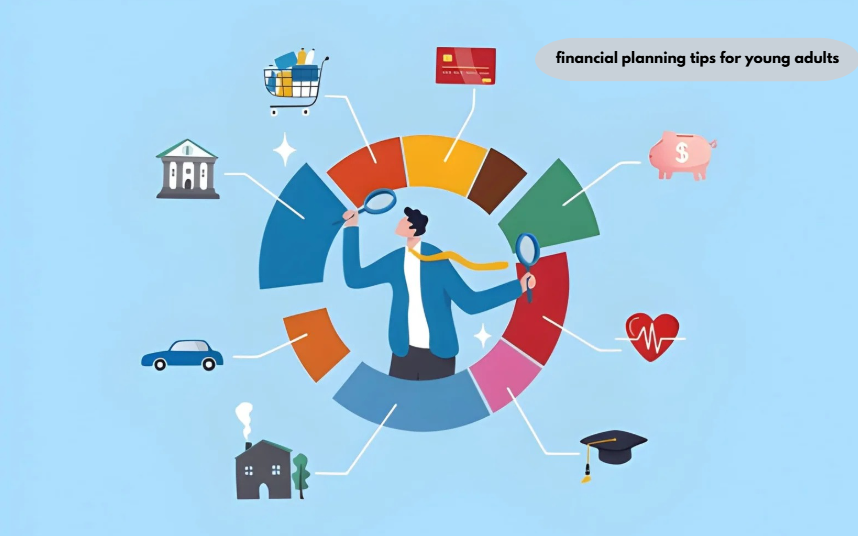
Financial planning means deciding ahead of time what job each dollar you earn will have so that today’s bills, short-term goals, and retirement all get funded in an intentional sequence.
What are the most important financial planning tips for young adults?

The most important tip is to follow a fixed order: stabilize first, then eliminate expensive debt, then invest. The sequence matters more than the dollar figures, since each step safeguards the next.
- Track one full month of spending. Export your bank and card statements and sort every charge into fixed bills, flexible spending, and waste.
- Save a starter emergency fund of $1,000. Put it in a dedicated savings account so you don’t accidentally dip into it
- Contribute enough to get the full employer match. With a dollar-for-dollar match, your contribution is doubled the moment you make it.
- Pay off debt charging more than about 8% APR. Above that rate, debt costs more than long-term investments are expected to earn.
- Grow the emergency fund to three months of essential costs. Count only rent, food, transport, insurance, and minimum debt payments.
- Raise retirement contributions by 1% of pay each year. Stop when you reach 15% of gross income.
Step 3 sits ahead of debt payoff for one reason: no credit card charges 100% interest, and a full match pays exactly that on the matched dollars.
How do you cut spending and save when your income is low?
Cut recurring bills first, then automate a small transfer on payday. Recurring cuts repeat every month without further effort, while one-off sacrifices have to be made again and again.
Only 63% of U.S. adults said they would pay for a surprise $400 bill entirely with cash or its equivalent, according to the Federal Reserve’s Economic Well-Being of U.S. Households in 2024 report, published in May 2025. That leaves more than one in three adults reaching for a card or a loan, which is why your first $400 saved does more for you than your first $400 invested.
Which bills should you cut first?
Begin with your auto-renewing bills, since a single change cuts the cost of every month that follows. The fastest answer to how to reduce monthly expenses is a single afternoon spent on four items.
Here is a worked example for someone taking home $2,600 a month:
- Phone: moving from a $65 postpaid plan to a $25 prepaid plan saves $40.
- Subscriptions: Cancelling two of four streaming and app subscriptions saves $32.
- Car insurance: requesting three new quotes and switching saves $28.
- Food: Planning five dinners a week and dropping one delivery order a week saves $90.
The total is $190 a month, or 7.3% of take-home pay. At that pace the $1,000 starter fund is complete in the sixth month, and the yearly total reaches $2,280.
How do you make saving automatic?
Set the transfer to go out on the same day your paycheck arrives. Learning how to save money fast on a low income comes down to moving the money before it reaches your spending account, so the decision is made once instead of every week.
Start with the amount your bill cuts freed up. Raise it by $10 each time your pay rises or a debt is cleared.
Where should you keep savings so they grow without risk?
Keep money you need within three years in an insured, interest-paying account and accept a modest return in exchange for certainty. The honest answer to how to grow your money safely is to match each dollar to the date you will need it.
Use this decision rule:
- Needed within 3 years: insured savings account.
- Not needed for at least 12 months, and you want inflation protection: U.S. savings bonds.
- Not needed for 5 years or more: diversified investment funds.
Savings accounts nationwide paid an average of 0.38% in August 2026, according to the FDIC’s National Rates and Rate Caps update. On a $5,000 emergency fund that is $19 a year, while the same balance in an online account paying 4.00% earns $200, a gap of $181 for ten minutes of paperwork.
The 0.38% figure is an average across the whole banking market, not an offer from any one bank. Individual banks set their own rates, so compare at least three before opening an account and confirm the account is federally insured.
Where should a beginner invest first?
A beginner should invest first in a workplace retirement plan up to the match, then in a Roth IRA. The best answer to where to invest money for beginners is a tax-advantaged account holding a low-cost index fund.
Individual stocks are the riskiest way to start, because one company’s bad year can erase the position. A broad index fund holds hundreds of stocks at once, so no single failure decides your result.
Every example on Money BetterThisWorld follows the same order: choose the account first, then choose the fund inside it.
According to the IRS’s November 2025 announcement, you can contribute up to $7,500 to an IRA in 2026. Spread over 12 months, that is $625, and a starting amount of $50 a month uses the same account and the same tax treatment.
| Option | Best used for | Key 2026 figure | Main trade-off | Source |
| Insured savings account | Emergency fund | Deposits insured up to $250,000 | Rate changes at any time | FDIC |
| Series I savings bond | Money you won’t need for at least a year | 4.26% composite rate on bonds issued May through October 2026, including a 0.90% fixed rate | Locked for the first 12 months | TreasuryDirect |
| Workplace 401(k) | Matched retirement saving | Employee contributions capped at $24,500 | Early withdrawals are usually penalized | IRS |
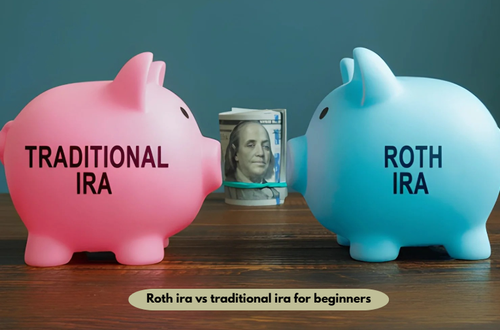
| Roth IRA | Tax-free growth outside work | Single filers begin to lose eligibility at $153,000 of income. | Annual contribution cap | IRS |
The I bond rate is a set offer for bonds bought in that window and resets in November 2026. The savings average above describes the whole market, so the two numbers are not a like-for-like comparison.
How much does starting early matter?
Starting ten years earlier more than doubles the result on the same monthly amount. Assume $150 a month and a 7% average annual return, which is an assumption for illustration and not a guarantee.
- Start at 25, stop at 65: you contribute $72,000 and finish with about $394,000.
- Start at 35, stop at 65: you contribute $54,000 and finish with about $183,000.
The extra $18,000 contributed in your twenties produces roughly $211,000 more at 65. No later contribution works as hard as the earliest one.
What is the most expensive money mistake in your twenties?

The costliest error is putting spare money into investments while you still owe on a credit card. It happens because investing feels like progress and debt payments feel like loss.
Take a $3,000 balance on a card charging 24% APR. Interest runs about $60 a month, or $720 a year, and an investment would need to return 24% just to break even against it.
The fix is specific: keep contributing enough to get the employer match, pause all other investing, and send the difference to the card. Paying $250 a month clears that $3,000 balance in roughly 14 months, after which the entire $250 goes toward investing.
How do you judge money advice you find online?
Judge online money advice by its date, its author, and how the page earns income. Apply that test to every website you read, including this one.
Treat every page of money information the same way:
- Verify the rates and limits are up to date for the present year .
- Look for a named author and a clear description of who runs the website.
- Notice whether the page is paid when you open the product it recommends.
- Confirm any figure with a government or regulator source first, then act on it.
Free information from regulators and tax agencies is the benchmark. Advice that promises a fixed return, urges speed, or asks for payment in crypto or gift cards fails the test immediately.
The usual order does not fit everyone. If your income is irregular, as with gig work, commissions, or seasonal jobs, a $1,000 starter fund is too thin, because your risk is a slow month rather than a single surprise bill. Build one full month of essential costs before chasing the match, and base your budget on your lowest-earning month of the past year, not your average.
Frequently Asked Questions
How much should a young adult save each month?
Target 20% of your take-home pay for savings, investing, and extra debt payments combined, and begin with whatever amount you can automate right now. On $2,600 a month, 20% is $520. Starting at 7% and adding one percentage point every few months reaches that target without a sudden lifestyle cut.
Should I pay off debt or invest first?
Take the full employer match first, then pay off any debt above about 8% APR before investing more. Debt below that rate, such as many federal student loans, is fine to repay on schedule while you invest.
How much money do I need to start investing?
You need very little, because many brokerages and retirement plans accept contributions of $50 a month or less. The habit counts for more than the amount. Money BetterThisWorld’s worked example uses $150 a month, but a small automatic contribution you start today is better than a big one you intend to make someday.
Is a Roth IRA or a 401(k) better for a young adult?
A 401(k) with a match comes first, and a Roth IRA comes second. The match is free money, while the Roth suits lower earners because contributions are taxed now, at a low rate, and withdrawals in retirement are tax-free.
How big should an emergency fund be?
A full emergency fund covers three to six months of essential costs, built after a $1,000 starter fund. Go with three months if your pay is steady and no one depends on you. Go with six if your income varies, your household relies on one earner, or you work in an unstable industry.
Conclusion
The best financial planning tips for young adults are about order, not income: stabilize, clear expensive debt, then invest automatically. Start at 25 with just $190 a month, and you’ll beat a better-paid person who delays until 35. Of everything you own, time is the one thing that is at its peak today.