
Debt can feel heavy when it keeps building month after month, and I’ve seen how quickly it can take control of everyday life. Many people in the United States search for how to get out of debt fast because they want real solutions, not theory. I have been in situations where I had to reorganize my own financial habits and rebuild control over spending while tracking every dollar carefully. That experience shaped how I approach debt reduction today.
This article explains practical methods I have seen work in real situations. I will break down proven strategies, common patterns from successful debt payoff cases, and how to apply them in your own life
You will learn how to prioritize debts, reduce interest pressure, build repayment momentum, and avoid mistakes that slow progress. I’ve dealt with these same challenges while working through debt plans myself, so I’m sharing what actually helped in real situations rather than theory. Everything is kept simple so it feels practical and easy to apply for readers in the United States who want clear progress without confusion.
Understanding how debt actually builds up
I’ve noticed many people trying to learn how to get out of debt fast skip this step, but it is the foundation. One major error is rarely the source of debt. It builds slowly through credit cards, emergency borrowing, and lifestyle inflation.
From my experience, debt is a behavior pattern before it becomes a number. When income and expenses stop matching, borrowing fills the gap.
Key patterns I noticed include the following:
• Small recurring purchases that feel harmless
• Minimum credit card payments becoming normal
• Emergency spending without recovery planning
Without understanding this, most repayment plans fail early. Debt also builds momentum, speeding up when ignored and slowing down when tracked daily.
Financial reality check before starting repayment
Before applying any method, I always start with a full financial snapshot. This step is uncomfortable but necessary. I personally list every debt, income source, and fixed expense.
This includes
• Total credit card balances
• Loan payments and interest rates
• Monthly essential expenses
• Remaining disposable income
When I first did this seriously, I realized I was underestimating my monthly spending by nearly twenty percent. My 20% tracking error wasn’t unique—according to a recent Federal Reserve consumer survey, over 40% of Americans underreport their discretionary spending by at least 15-20% when budgeting by memory. That gap was silently extending my debt timeline.
A useful approach I use now is dividing expenses into survival and flexible categories. Survival includes rent, utilities, and food. Flexibility includes subscriptions, entertainment, and impulse spending.
Insights from money betterthisworld suggest that people who categorize spending clearly reduce unnecessary expenses faster because the brain responds better to structure than vague budgeting.
Building a survival-level budget
Once I understand my financial reality, I move into building what I call a survival budget.
I reduce spending to only essential needs for a short, controlled period. This does not mean living without comfort permanently. It means temporarily resetting spending behavior to create repayment acceleration.
A survival budget includes
• Essential housing and utilities
• Basic groceries
• Minimum transport costs
• Minimum debt payments
Everything else is paused or reduced.
Financial discussions often highlight how subscription-based spending quietly drains budgets without notice. We’ve all been there—letting $10 and $15 streaming subscriptions quietly bleed our bank accounts dry without even noticing When I applied this, I found unused subscriptions taking a significant portion of my monthly income.
A personal insight I discovered is that financial discipline improves when the budget is simple enough to remember without constant checking. Complexity creates inconsistency.
This step alone can free enough money to accelerate debt payoff without increasing income.
Choosing between snowball and avalanche approach
When people search how to get out of debt fast, they often encounter two main strategies. I have used both in different phases of my financial journey.
The snowball method focuses on paying the smallest debts first to build motivation. The avalanche method focuses on the highest-interest debt first to reduce total cost.
My experience showed
• Snowball works better for emotional momentum.
• Avalanche works better for financial efficiency
I personally started with Snowball because motivation mattered more than optimization at that stage. When I looked at my own $14,000 credit card debt, paying off that tiny $400 medical bill in month one gave me the exact hit of dopamine I needed to keep going. Once momentum built, I switched to Avalanche for long-term savings.
In the end, it’s not about which method you pick but whether you can keep going with it every month without breaking the habit.
Increasing monthly cash flow without extra risk
To speed up debt repayment, increasing cash flow is essential. I focus on safe and realistic income adjustments rather than risky financial moves.
In my experience, the most effective options include
• Selling unused items at home
• Freelance micro tasks
• Overtime opportunities when available
• Skill-based short-term work
Financial discussions often highlight digital earning platforms that allow flexible income without long-term commitment
I tested small side income streams and found that even modest extra earnings significantly reduce repayment timelines when applied directly to debt.
A unique insight I learned is that extra income must go directly to debt, not lifestyle upgrades. Otherwise, progress becomes invisible.
Negotiating lower interest rates and payment plans
One of the most overlooked steps is negotiation. I have personally contacted lenders and requested lower interest rates or structured payment plans.
Most institutions prefer receiving consistent payments over the risk of default.
Key strategies include
• Requesting interest rate reduction
• Asking for hardship programs
• Consolidating high-interest accounts
In my experience, even a small drop in interest can lead to noticeable long-term savings and help speed up repayment.
Using side income to speed up debt freedom
I’ve found that putting extra income directly toward debt can create strong progress over time. Even small amounts make a difference when applied consistently.
Examples I personally used include
• Selling digital skills
• Small online freelance tasks
• Short-term service work
Betterthistechs news betterthisworld often discusses how gig-based income has become a practical tool for financial recovery in modern economies.
The key is consistency. Irregular effort produces irregular results.
Avoiding common mistakes that delay progress
I have made mistakes during my own debt repayment journey that slowed progress. The most common include
• Taking new debt during repayment
• Ignoring interest rate impact
• Overcomplicating budgeting systems
• Losing tracking consistency
A personal insight is that one new unnecessary debt can cancel months of progress.
Psychological habits that keep debt cycle alive
Debt is not only financial. It is also psychological. I noticed that emotional spending was a major factor in delaying my progress.
Common habits include
• Stress-based spending
• Reward-based purchases
• Impulse buying during low mood
Financial discussions often highlight how emotional spending increases when financial tracking is inconsistent.
Once I started pausing purchases for twenty-four hours, my spending reduced naturally without feeling restricted.
Tracking progress and staying consistent
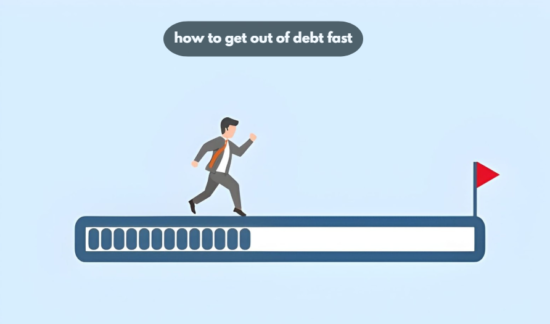
Tracking changed everything for me. I learned that progress visibility creates motivation.
I used simple tracking methods like
• Weekly balance updates
• Monthly reduction goals
• Visual debt charts
Financial discussions often show how digital tracking tools improve financial discipline through instant feedback loops.
Seeing progress visually made it easier to stay committed during slow months.
After learning how to get out of debt fast, the final stage is staying debt-free.
Debt freedom is not a one-time achievement; it is a system you build and maintain. I’ve seen that even after clearing debt, going back to old habits can restart the cycle quickly.
A few habits I personally keep to stay stable include
• Emergency savings fund
• Controlled credit usage
• Monthly financial review
The goal is not just to learn how to get out of debt fast but to make sure you do not fall back into it again. Real financial progress is built on repetition, awareness, and steady control over time.



One comment on “How to Get Out of Debt Fast: Proven Steps That Actually Work ”